Food-grade sodium hyaluronate can be used in dietary supplements in the form of capsules, tablets, powders, beverages, gummies, and gels. However, “food grade” does not mean that the same raw material can be directly used in every product. The right selection must take into account the product dosage form, amount per serving, formula composition, processing conditions, target mouthfeel, packaging, and storage environment.
For projects involving the development or procurement of sodium hyaluronate, it is advisable to first understand the basic properties of the raw material, then confirm product suitability, review the COA and specification documents, and finally verify actual performance through sample testing. Different products require different priorities: solid dosage forms focus more on powder flowability and fill-weight consistency, powders on moisture absorption and dispersion, beverages on clarity and storage changes, and gummies on heating, molding, and texture stability.
1. What Is Food-Grade Sodium Hyaluronate?
Hyaluronic acid is a polysaccharide that naturally occurs in human tissues and has the ability to bind water. Sodium hyaluronate is the sodium salt form of hyaluronic acid and is commonly used as a white or off-white powder raw material. Because of its water solubility, water-retention properties, and good formulation adaptability, sodium hyaluronate is used in oral beauty, joint health, and daily nutritional supplement products.
“Food grade” mainly indicates that the raw material is intended for oral applications such as foods or dietary supplements and must be produced, tested, packaged, and stored according to the corresponding quality requirements. However, food grade is not a final judgment independent of a specific product. Whether the raw material is truly suitable for a particular supplement also depends on its specification range, molecular weight or viscosity, purity, moisture content, microbiological profile, heavy metals, powder condition, and performance in the actual formulation.
Sodium hyaluronate can also be differentiated according to different uses and quality requirements. Raw materials of different grades may differ in application scope, testing items, processing requirements, and documentation systems. Therefore, materials with similar names should not be substituted directly. Understanding the differences between hyaluronic acid grades helps clarify the intended product use during raw material selection and prevents materials unsuitable for oral supplements from being used in food or dietary supplement products.
For further reading: What Are The Different Grades of Hyaluronic Acid?
2. What Products Are Suitable for Food-Grade Sodium Hyaluronate?
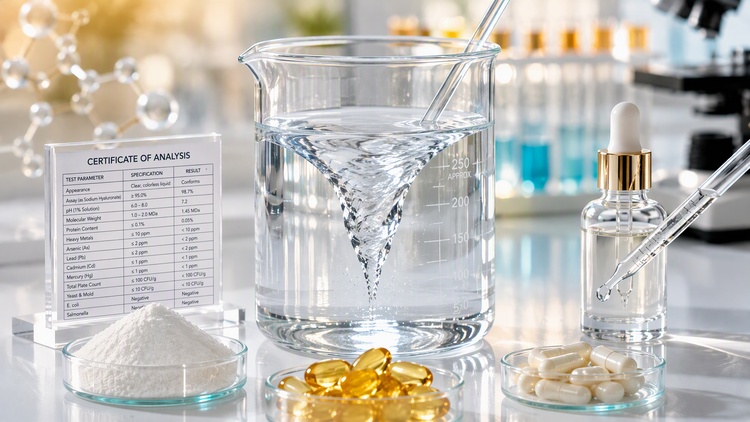
Food-grade sodium hyaluronate can be used in a variety of supplement dosage forms, but the raw material requirements differ between dosage forms. During selection, first determine how the product will be used and manufactured, then assess whether the powder, solution, or finished-form performance of the raw material meets the requirements.
Capsules and Tablets
Capsules and tablets are solid dosage forms. Their key considerations generally include powder flowability, blending uniformity, filling or compression performance, and moisture exposure during storage. If sodium hyaluronate differs significantly from other powders in particle size, density, or flowability, blending uniformity and unit fill weight may be affected. Tablets also require observation of hardness, friability, and disintegration, while capsules require attention to filling smoothness and fill-weight consistency.
Powders and Sachet Products
Powder and sachet products require consideration of both the condition inside the package and the reconstitution experience. Whether the raw material absorbs moisture and forms lumps during transport or after opening can affect handling and dosing. After water is added, the speed of dispersion and the presence of wall adhesion, sedimentation, or obvious agglomeration can affect the user experience. If consumers are expected to prepare the product themselves, testing should reflect the actual water volume, water temperature, and mixing method.
Ready-to-Drink Beauty or Nutritional Beverages
For beverages, the main requirements typically involve clarity, sedimentation, separation, viscosity, mouthfeel, and shelf-life stability. Once sodium hyaluronate enters a liquid system, it may also be affected by acidity, minerals, sugar alcohols, botanical extracts, vitamins, flavors, preservative systems, and heat-treatment conditions. Therefore, it is not sufficient to observe clarity in pure water; the material must also be evaluated in a system close to the final formulation.
Gummies and Gel Products
Gummies and gel products involve heating, mixing, cooling, and molding steps. Particular attention should be paid to the effects of sodium hyaluronate on system viscosity, molding, hardness, surface condition, stickiness, syneresis, and mouthfeel. Storage and transportation conditions should also be evaluated after molding, because the condition immediately after molding in the laboratory may not represent the final condition throughout the shelf life.
The requirements for sodium hyaluronate in different dosage forms are generally closely related to the formulation structure and processing conditions of the dietary supplement. When applying the raw material to a supplement, product form, addition method, and final user experience should be considered together rather than judged separately from the product.
3. How Should the COA for Food-Grade Sodium Hyaluronate Be Read?
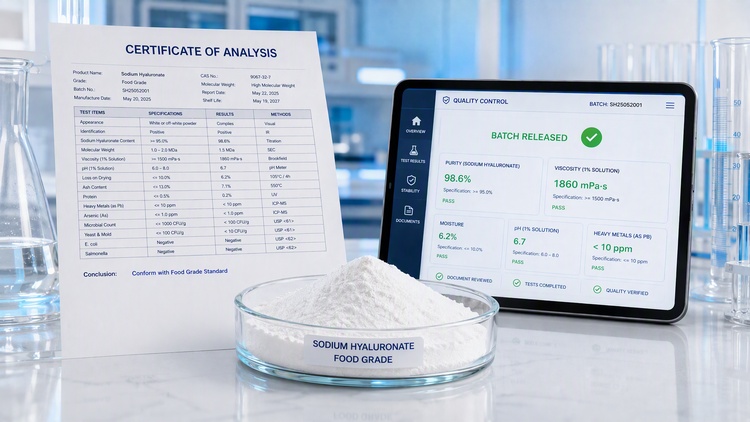
A COA, or Certificate of Analysis, is generally used to record the test results for a specific batch of raw material. Its purpose is not merely to prove that the product “passes,” but also to confirm whether the identity of the batch, test items, actual results, and specification requirements correspond to one another. When reading a COA, the product name, batch number, test date, test items, results, units, specification limits, and test methods should be reviewed together.
First, confirm that the product name on the COA matches the food-grade sodium hyaluronate actually purchased and that the batch number corresponds to the outer packaging or sample label. The production date, test date, and shelf life should also be consistent. If the relationship between the COA and the sample batch is unclear, the document will be difficult to use for subsequent traceability even if the listed test items appear complete.
Next, review the key physicochemical indicators. Common items include molecular weight or viscosity, purity, moisture content, appearance, color, and odor. Molecular weight or viscosity must be interpreted together with the test concentration, temperature, solvent, test method, and unit, because values obtained under different test conditions may not be directly comparable. Purity can reflect the basic quality of the raw material, but it cannot replace observation of powder condition, formulation compatibility, and storage performance. Moisture content is related to moisture absorption, lump formation, flowability, and storage stability.
Then confirm whether microbiological and heavy-metal items are listed with specific results, units, limits, and test methods. If the document only states “complies with requirements” without listing specific items, it is not possible to determine whether the documentation covers the needs of the current product. For oral supplement raw materials, test documentation should correspond to a specific batch and records should remain continuous once the project enters ongoing procurement.
Finally, confirm the relationship between the COA and the specification sheet. The specification sheet generally states the required range of product indicators, while the COA reflects the actual test results for a specific batch. Reviewing both documents together provides an understanding of both “what the standard requires” and “how this batch actually performed.”
For additional information about the applications and formulation considerations of sodium hyaluronate in dietary supplements, see Sodium Hyaluronate in Dietary Supplements: Applications and Formulation Considerations.
4. How Should the Molecular Weight of Food-Grade Sodium Hyaluronate Be Selected?
Molecular weight affects the viscosity, dispersion process, and mouthfeel of a sodium hyaluronate solution, but it cannot be simply understood that a higher molecular weight means a better raw material. When selecting molecular weight, the product dosage form, amount added, formulation composition, processing temperature, target mouthfeel, and storage requirements should be evaluated together.
For powder products, in addition to the viscosity of the final solution, the hydration speed, tendency to form agglomerates, and uniformity after mixing with water should be observed. If consumers need to prepare the product quickly, dispersion under the actual water volume and temperature may be more important than a single molecular-weight value. For beverages, higher viscosity may change the drinking experience and may also affect filtration, filling, and clarity, so the liquid condition must be confirmed in the final formulation.
For capsules and tablets, the raw material generally needs to be blended with other powders before filling or compression. In this case, molecular weight alone cannot directly indicate powder flowability, fill-weight uniformity, or molding performance. The moisture content, particle size, blending condition, and stability during processing must also be observed.
When comparing the molecular weight or viscosity of different raw materials, confirm that the testing conditions are consistent. Changes in concentration, temperature, solvent, or test method may affect the results. Data comparison is more meaningful only when the test methods and sample-treatment conditions are similar. Therefore, molecular weight is suitable for narrowing the selection range, but the final judgment should still rely on sample testing under conditions close to the actual product.
5. What Are the Common Problems with Food-Grade Sodium Hyaluronate in Different Dosage Forms?
Common Problems in Capsules and Tablets
Capsules and tablets may experience unstable powder flow, uneven blending, fill-weight variation, compression abnormalities, or changes in disintegration. If sodium hyaluronate differs significantly from other powders in particle size, density, and flowability, segregation may occur during storage or conveying. When the powder absorbs moisture, wall adhesion, lump formation, filling problems, or changes in tablet formation may also occur.
Common Problems in Powders
Common problems with powders include moisture absorption, lump formation, slow dispersion, uneven reconstitution, wall adhesion, and sedimentation. A raw material that is in good condition immediately after opening may not remain the same after repeated opening or short-term exposure to a humid environment. Testing should simulate the actual packaging, handling method, water volume, and water temperature, and should record the time required for the material to form a uniform system after addition.
Common Problems in Beverages
Beverages may develop turbidity, sedimentation, separation, increased viscosity, off-odors, or color changes. These issues may result from interactions between sodium hyaluronate and acidulants, minerals, botanical ingredients, vitamins, or other formulation components. They may also be related to the order of addition, mixing, heat treatment, filtration, packaging, and storage time. Therefore, the final beverage should not be judged solely on the raw material’s performance in pure water.
Common Problems in Gummies and Gel Products
Gummies and gel products may show changes after heating, stickiness, adhesion, syneresis, deformation, changes in hardness, or off-odors. A raw material may perform normally in the liquid stage but still cause problems after molding because of colloid compatibility, cooling rate, or storage temperature. Testing should record the condition during heating, mixing, cooling, molding, and storage.
6. What Must Be Tested in Food-Grade Sodium Hyaluronate Samples?
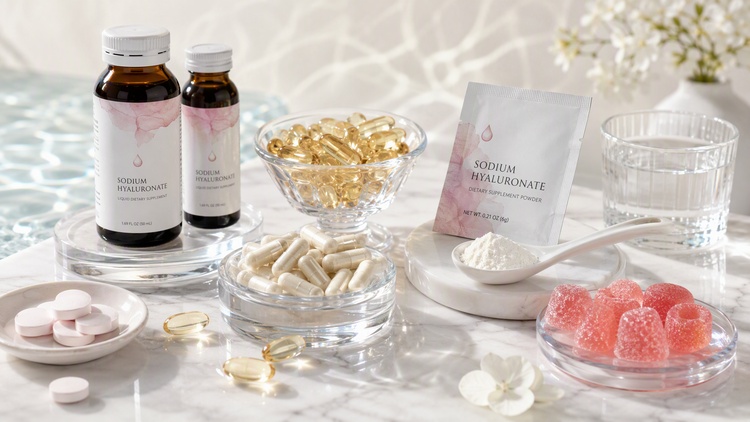
Sample testing should be designed around the actual product rather than limited to a single dissolution test. At minimum, testing can begin with the following categories.
Powder Condition
Record the sample’s appearance, color, odor, looseness, lump formation, wall adhesion, and moisture absorption. At the same time, retain the sample batch number, packaging photographs, and opening date for subsequent comparison. If the sample has obvious lumps upon arrival or the package seal is abnormal, transportation and storage conditions should be checked first.
Basic Dispersion and Dissolution
Under fixed water volume, water temperature, and mixing conditions, record the time from addition until a uniform system is formed. Observe whether lumps form quickly, whether the material adheres to the container, whether it settles, and whether changes occur after standing. Different samples should be tested under the same operating conditions as far as possible to prevent differences in test methods from affecting the conclusion.
Compatibility with the Final Formulation
Add the sample to a formulation system close to the final product and observe clarity, turbidity, sedimentation, separation, viscosity, color, odor, and mouthfeel. Particular attention should be paid to the effects of acidulants, minerals, botanical ingredients, vitamins, protein ingredients, and other functional ingredients.
Process Simulation
If the product includes heating, filtration, concentration, filling, compression, cooling, or gel formation, sample testing should simulate these processes as closely as possible. Different processing conditions may change the dispersion and liquid performance of sodium hyaluronate and may also affect the final condition of gummies, gels, tablets, or beverages.
Storage and Batch Comparison
Observe the sample under the storage temperatures, time periods, and packaging conditions that the product may experience. Record changes in sedimentation, separation, lump formation, viscosity, color, odor, and texture. For products intended for ongoing use, different batches should also be reviewed to determine whether raw material performance is repeatable.
7. What Materials Can Be Provided When Purchasing Sodium Hyaluronate from Runxin Biotech?
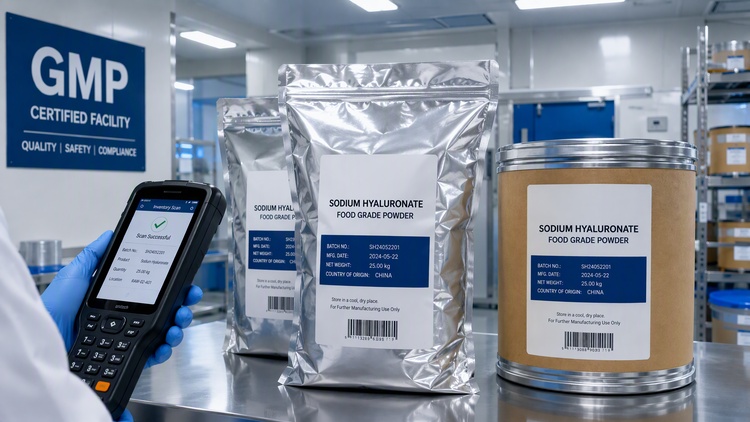
When purchasing food-grade sodium hyaluronate, the required documentation can be confirmed around product identity, quality indicators, batch traceability, and application management. The materials that Runxin Biotech can actually provide should be determined according to the specific product, batch, and project confirmation. Before formal procurement, the following items can be confirmed:
Product specification sheet, used to understand the product name, indicator ranges, and basic quality requirements;
COA or a test report for the corresponding batch, used to review the specific test results for that batch;
Information on molecular weight, viscosity, purity, moisture content, and other indicators, used for specification comparison and product suitability assessment;
Microbiological and heavy-metal test documentation, used to confirm basic testing information for oral supplement raw materials;
Packaging specifications, storage conditions, and shelf-life information, used to arrange transportation, warehousing, and post-opening management;
Sample information, batch details, and available application-testing recommendations, used for formulation compatibility and dosage-form verification.
The names and scope of the available documents may vary according to product specifications, procurement batches, and project requirements. Therefore, when confirming the documentation, the product model, target dosage form, expected purchase volume, and intended use of each document should also be clarified. This helps avoid requesting only a general document while overlooking the requirements of the actual project.
8. What Are the Common Questions When Purchasing Food-Grade Sodium Hyaluronate?
Is food-grade sodium hyaluronate suitable for all dietary supplements?
Not necessarily. Food grade indicates that the raw material is intended for food or dietary supplement applications, but suitability for a specific product also depends on the dosage form, amount added, formulation composition, processing steps, and storage conditions. Capsules, powders, beverages, and gummies do not require the same quality priorities.
How should molecular weight and viscosity be selected according to the dosage form?
First determine the condition the product needs to achieve, and then screen molecular weight and viscosity accordingly. Beverages generally require attention to clarity, drinking experience, and long-term stability; powders require attention to reconstitution and dispersion; and solid dosage forms should be evaluated together with powder blending, filling, or compression. The final result must be confirmed through sample testing.
Which indicators in a COA require the most attention?
The product name, batch number, test date, molecular weight or viscosity, purity, moisture content, microbiological results, heavy metals, test results, units, specification limits, and test methods should be reviewed carefully. Also confirm that the COA corresponds to the actual sample and procurement batch.
Should sample testing use a system close to the final formulation?
It is recommended. Pure-water testing can help reveal the basic dispersion condition of the raw material, but it cannot represent the performance of the material in an acidic formulation or one containing minerals, botanical ingredients, vitamins, or proteins. The closer the test is to the final formulation and process, the more useful the result will be.
How should the minimum order quantity, packaging specifications, and delivery time be confirmed?
These details should be confirmed separately according to the specific product, batch, packaging format, and procurement plan. When communicating, provide the target dosage form, estimated quantity, packaging requirements, delivery location, and schedule to obtain more accurate procurement information.
How can consistency between different batches be confirmed?
Batch numbers, test reports, sample-testing records, and key appearance or powder-condition observations should be retained. During ongoing procurement, the dispersion, dissolution, viscosity, mouthfeel, and storage performance of different batches can be compared under the same formulation and process conditions.
How should the raw material be stored, opened, and managed?
The raw material should be managed according to the storage conditions specified in the product documentation, with attention to temperature, humidity, sealing, and exposure time after opening. After use, the powder package should be resealed promptly to avoid prolonged exposure to humid conditions. If changes occur in lump formation, color, odor, or flowability, the batch number should be recorded and the cause should be further confirmed.
What information should be confirmed with the manufacturer before purchase?
At minimum, confirm the product specification sheet, COA, key quality indicators, test methods, packaging specifications, storage conditions, shelf life, batch information, and sample-support scope. For projects involving special dosage forms or processing conditions, product requirements should also be explained in advance so that the suitability of the raw material for further testing can be assessed.
For additional information about the basic characteristics of sodium hyaluronate powder, see What are the benefits of sodium hyaluronate powder?.
9. Conclusion
The selection of food-grade sodium hyaluronate should not be based only on price, the food-grade designation, or a single test value. A more reliable approach is to first confirm the product dosage form and formulation requirements, then review the specification sheet and COA, verify the actual performance of the powder, liquid, or molded system through sample testing, and finally check the packaging, storage, batch, and traceability information.
Food-grade sodium hyaluronate can be used in capsules, tablets, powders, beverages, gummies, and gel-based dietary supplements, but different products require different screening priorities. Molecular weight and viscosity should be evaluated together with the addition level, formulation, and mouthfeel; purity and moisture content should be observed together with powder condition; and microbiological, heavy-metal, and batch information should correspond to the specific COA. Sample testing should not stop at dispersion in pure water, but should also cover the actual formulation, processing conditions, and storage environment as far as possible.
For procurement projects, it is advisable to prepare a clear documentation checklist before confirming the raw material and define the product dosage form, target amount, formulation composition, processing conditions, packaging format, and storage requirements. Only when the specification documents, sample performance, batch consistency, and subsequent materials correspond to one another can there be a sound basis for determining whether a food-grade sodium hyaluronate is truly suitable for a specific dietary supplement product.