Injectable Grade Sodium Hyaluronate Powder is exceptionally beneficial for the skin, serving as the premium gold standard active pharmaceutical ingredient for deep dermal hydration, extracellular matrix restoration, tissue volumization, and advanced dermal filler formulations due to its ultra-high purity, precise molecular weight control, and exceptionally low bacterial endotoxin content.
At a Glance
| Section | Summary |
| Biochemical Fundamentals of Injection Grade Sodium Hyaluronate | An analysis of the glycosaminoglycan molecular structure, fermentation origin, and strict pharmaceutical purity requirements separating injection grade powder from lower cosmetic grades. |
| Cutaneous Benefits and Skin Physiology Interactions | A deep dive into how high-purity hyaluronic acid restores the dermal extracellular matrix, boosts skin hydration, stimulates collagen synthesis, and accelerates repair. |
| Rheological Behavior and Molecular Weight Customization | An examination of high, medium, and low molecular weight fractions, intrinsic viscosity parameters, and cross-linking behaviors for optimal dermal integration. |
| Endotoxin Control, Biocompatibility, and Safety Profiling | A detailed review of strict bacterial endotoxin limits, bio-burden sterilization standards, and toxicological safety profiles crucial for medical devices. |
| Industrial Manufacturing and Quality Control Standards | Insights into cGMP manufacturing compliance, HPLC purity testing, batch-to-batch consistency, and European regulatory market preferences. |
| Formulation Guidelines for Dermal Fillers and Mesotherapy | Technical instructions on hydration kinetics, cross-linking agent selection, thermal stability management, and packaging requirements for injectable products. |
| Strategic B2B Sourcing and Technical Evaluation | Guidance on vendor evaluation, regulatory documentation analysis, Certificates of Analysis verification, and cost-to-performance optimization. |
Biochemical Fundamentals of Injection Grade Sodium Hyaluronate
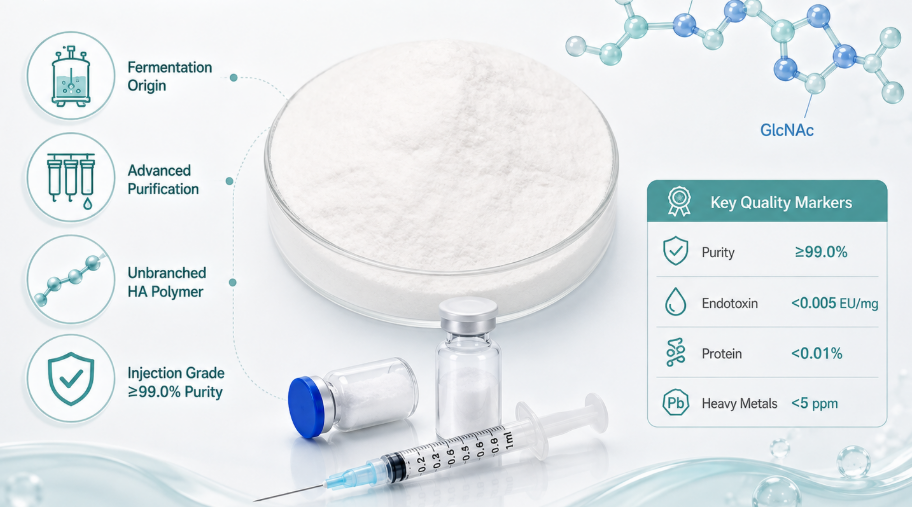
Injection Grade Sodium Hyaluronate Powder represents the highest purity level of sodium hyaluronate, engineered through specialized bacterial fermentation and multi-stage purification to achieve a bio-compatible, non-immunogenic polysaccharide suitable for parenteral and intradermal applications.
Sodium Hyaluronate is a naturally occurring linear glycosaminoglycan composed of repeating disaccharide units of D-glucuronic acid and N-acetyl-D-glucosamine linked by alternating beta-1,4 and beta-1,3 glycosidic bonds. When produced for medical and injection applications, the manufacturing process relies on controlled Streptococcus zooepidemicus fermentation. Unlike cosmetic-grade variants that allow higher residual protein levels, injection-grade material undergoes advanced ultrafiltration, ethanol precipitation, and specialized ion-exchange chromatography to remove cellular debris, heavy metals, and nucleic acids.
From a structural perspective, the key differentiator between raw material grades lies in purity, structural integrity, and trace impurities. Injection grade material maintains an unbranched, high molecular weight polymeric chain that mimics endogenous human hyaluronic acid found within the cutaneous extracellular matrix.
| Parameter | Cosmetic Grade | Topical Medical Grade | Injection Grade |
| Sodium Hyaluronate Purity | Greater than or equal to 95.0% | Greater than or equal to 98.0% | Greater than or equal to 99.0% |
| Bacterial Endotoxin Level | Not strictly controlled | Less than 0.5 EU per mg | Less than 0.005 EU per mg |
| Protein Content | Less than 0.10% | Less than 0.05% | Less than 0.01% |
| Nucleic Acid Content | Not tested | Less than 0.5 Abs at 260nm | Less than 0.1 Abs at 260nm |
| Heavy Metals Total | Less than 20 ppm | Less than 10 ppm | Less than 5 ppm |
| Molecular Weight Range | 0.01 to 1.8 MDa | 0.8 to 2.0 MDa | 0.5 to 3.0 MDa |
Understanding these fundamental differences is crucial for cosmetic chemists and medical device manufacturers. Using lower purity grades for intradermal injections or advanced aesthetic formulations risks severe immunogenic reactions, tissue granulomas, and rapid enzymatic breakdown. Incorporating refined Injectable grade sodium hyaluronate for medical cosmetology guarantees high physiological stability and maximum tissue compatibility.
Cutaneous Benefits and Skin Physiology Interactions
Injection Grade Sodium Hyaluronate Powder provides superior dermal hydration, structural extracellular matrix support, tissue regeneration, and attenuation of senescence markers by restoring endogenous hyaluronic acid reserves within the deeper dermis.
When introduced into the skin, Injection Grade Sodium Hyaluronate Powder acts as a powerful humectant and structural scaffold. A single gram of high molecular weight sodium hyaluronate can hold up to six liters of water due to its extensive hydrogen-bonding network with water molecules. This high water-binding capacity directly increases dermal turgor, restores lost viscoelasticity, and smoothes fine lines and wrinkles from within the dermal layer.
Beyond superficial hydration, high-purity hyaluronic acid engages with specific cell surface receptors, primary among them being CD44. The binding of exogenous hyaluronic acid to CD44 receptors on dermal fibroblasts triggers signaling cascades that upregulate endogenous collagen type I synthesis, promote cell proliferation, and stimulate elastin production. This double action—physical volume expansion combined with cellular stimulation—makes it an unmatched active for anti-aging aesthetic procedures.
Extracellular Matrix Reconstruction: Restores the hydrated fluid gel network surrounding collagen and elastin fibers, preventing matrix collapse and structural sagging.
Fibroblast Activation: Engages cell receptors to increase natural pro-collagen synthesis and tissue repair pathways.
Radical Scavenging: Neutralizes reactive oxygen species generated by ultraviolet radiation and metabolic stress, protecting cellular DNA.
Barrier Function Enhancement: Improves intercellular lipid organization and reinforces dermal-epidermal junction integrity.
Industrial Application Insight: Why do we design high-purity polymers with specified viscoelastic properties? In practice, global cosmetic brands and medical clinic networks prioritize instant mechanical lifting paired with long-term biological rejuvenation. By maintaining strict molecular weight distributions, raw material manufacturers ensure that the injected polymer yields a uniform dermal spread without localized lumpiness or post-procedure edema.
Rheological Behavior and Molecular Weight Customization
The rheological performance and viscoelastic properties of Injection Grade Sodium Hyaluronate Powder are dictated by its average molecular weight and intrinsic viscosity, determining its lift capability, tissue residence time, and gel extrusion force.
Rheology—the study of liquid flow and deformation—is the core science behind formulating effective skin injections, dermal fillers, and high-performance skin boosters. Injection Grade Sodium Hyaluronate displays pronounced pseudoplastic behavior, meaning its viscosity decreases under shear stress during injection through fine needles and recovers immediately upon entering target dermal tissues.
The selection of molecular weight directly influences product performance. High molecular weight fractions offer greater water retention and structural lifting, whereas medium and lower fractions exhibit higher tissue diffusion rates and targeted cellular signaling profiles.
| Grade Specification | Molecular Weight Range | Intrinsic Viscosity | Primary Dermal Application |
| Extra High MW | 2.5 to 3.2 MDa | Greater than or equal to 3.8 m3 per kg | Cross-linked deep dermal fillers, cheek augmentation |
| Standard High MW | 1.8 to 2.5 MDa | 2.8 to 3.8 m3 per kg | Nasolabial fold correction, volume restoration |
| Medium MW | 1.0 to 1.8 MDa | 1.8 to 2.8 m3 per kg | Mesotherapy, skin revitalization, tear trough formulations |
| Low MW | 0.5 to 1.0 MDa | 1.0 to 1.8 m3 per kg | Hydro-booster combinations, superficial fine line treatments |
For cross-linked applications using cross-linking agents such as 1,4-butanediol diglycidyl ether, starting with high-purity Injectable grade sodium hyaluronate for medical cosmetology reduces the quantity of chemical cross-linker required to achieve desired viscoelastic moduli. This minimizes prospective toxicological exposure while maintaining superior gel durability against enzymatic degradation by endogenous hyaluronidase.
Working Principle: The shear-thinning capability of sodium hyaluronate polymer chains relies on dynamic entanglement. Under high pressure inside a fine-gauge syringe needle, polymer chains uncoil and align parallel to the flow direction, temporarily lowering viscosity. Once deposited inside the skin tissue, the shear rate drops to zero, and the polymer chains instantly re-entangle to reconstitute a thick, viscoelastic gel matrix.
Endotoxin Control, Biocompatibility, and Safety Profiling
Injection Grade Sodium Hyaluronate Powder requires strict endotoxin controls below 0.005 EU per milligram to eliminate the risk of pyrogenic reactions, late-onset inflammatory responses, and immunogenic reactions in clinical skin applications.
Bacterial endotoxins—lipopolysaccharides shed from the outer membrane of Gram-negative bacteria during fermentation—represent the single most critical safety hazard in parenteral raw materials. When introduced intradermally or subcutaneously, elevated endotoxin levels trigger fever, inflammation, tissue necrosis, and severe immune responses.
To achieve parenteral compliance, manufacturing processes employ continuous depyrogenation pipelines, closed-system membrane filtration, and ultra-clean water-for-injection systems. Testing using Limulus Amebocyte Lysate assay protocols ensures every batch meets rigorous international pharmacopeia standards, such as EP, USP, and JP requirements.
Biocompatibility testing for high-purity injection grade material spans cytotoxicity assays, acute systemic toxicity evaluations, intradermal reactivity testing, and mutagenicity screenings. Because the polymer structure is identical across mammalian species, pristine sodium hyaluronate exhibits zero species-specificity, yielding an exceptionally favorable safety profile for cosmetic and medical skin interventions.
Maintenance Considerations: To preserve low bio-burden levels and prevent hydrolytic degradation, dry powder batches must be stored in sealed, double-lined pharmaceutical-grade polyethylene bags housed inside light-resistant aluminum canisters at temperatures between 2 and 8 degrees Celsius. Humidity controls within storage areas must be maintained below 40% relative humidity to prevent moisture absorption.
Industrial Manufacturing and Quality Control Standards
Industrial production of Injection Grade Sodium Hyaluronate Powder demands adherence to current Good Manufacturing Practices, featuring validated cleanrooms, full lot traceability, and advanced high-performance liquid chromatography testing.
Producing pharmaceutical-grade sodium hyaluronate requires precise operational control over every stage of processing. Bacterial strain management uses non-pathogenic Streptococcus zooepidemicus cultures optimized for high-yield hyaluronic acid production without toxin generation. Fermentation parameters—including dissolved oxygen, pH balance, glucose feed rates, and temperature controls—are continuously monitored in real time.
Downstream purification processes avoid harsh chemical solvents that could leave toxic residues or shear the high molecular weight polymer chains. Quality control analytical testing protocols verify lot consistency before material release.
| Quality Control Test | Analytical Method | Pharmacopeial Acceptance Standard |
| Sodium Hyaluronate Content | High-Performance Liquid Chromatography / Carbazole Method | 99.0% to 101.0% (dry basis) |
| Molecular Weight Distribution | Size Exclusion Chromatography with Multi-Angle Light Scattering | Within plus or minus 5% of target specification |
| Bacterial Endotoxins | Limulus Amebocyte Lysate Kinetic Turbidimetric Assay | Less than 0.005 EU per mg |
| Loss on Drying | Vacuum Oven Drying at 105 degrees Celsius | Less than 10.0% |
| Heavy Metal Impurities | Inductively Coupled Plasma Mass Spectrometry | Lead less than 0.5 ppm, Arsenic less than 0.2 ppm |
| Protein Residue | Bradford Assay / Lowry Method | Less than 0.01% |
| Microbiological Count | Membrane Filtration Total Aerobic Microbial Count | Less than 10 CFU per gram |
European and North American aesthetic market clients prioritize raw materials backed by comprehensive regulatory documentation, including Drug Master Files, Certificate of Suitability to the Monographs of the European Pharmacopoeia, and ISO 13485 quality management certifications. Sourcing fully documented material streamlines final device registration and shortens time-to-market for brand owners.
Formulation Guidelines for Dermal Fillers and Mesotherapy
Formulating skin solutions with Injection Grade Sodium Hyaluronate Powder requires careful control over dissolution protocols, cross-linking chemistry, thermal sterilization cycles, and viscoelastic buffer conditions.
Formulators working with high-purity sodium hyaluronate powder must account for its intense hydratability and shear sensitivity. Adding powder directly into water can cause clumping, resulting in outer gel shells that insulate dry powder cores. Industrial dissolution mandates gradual powder addition into agitated Water for Injection at controlled speeds using specialized high-shear vacuum mixers.
For cross-linked dermal gels, controlling reaction pH and temperature is vital to prevent polymer backbone degradation during the addition of cross-linking agents like BDDE. Post-reaction washing steps via dialysis or continuous diafiltration remove unreacted cross-linker to non-detectable levels.
Dissolution Strategy: Use phosphate-buffered saline (pH 7.2 to 7.4) at room temperature with slow paddle agitation over 4 to 6 hours to achieve uniform polymer chain hydration without mechanical shearing.
Cross-Linking Optimization: Maintain BDDE concentrations below 1% relative to total hyaluronic acid mass, reacting at moderate alkaline pH (greater than 11.0) before neutralizing.
Thermal Protection: Minimize exposure to temperatures above 60 degrees Celsius during processing, as thermal stress breaks glycosidic bonds, dropping molecular weight and gel viscosity.
Terminal Sterilization: Utilize moist heat steam sterilization protocols (such as 121 degrees Celsius for 15 minutes) validated to ensure sterility assurance levels of 10 to the power of minus 6 while accounting for anticipated thermal degradation of intrinsic viscosity.
Formulation Tips: When engineering skin boosters for delicate eye or neck areas, blending un-crosslinked medium molecular weight hyaluronic acid with amino acids, antioxidants, and trace minerals creates synergistic biological activation. Incorporating top-tier Injectable grade sodium hyaluronate for medical cosmetology guarantees clean formulation profiles that integrate smoothly into target dermal zones without causing prolonged post-injection inflammation or swelling.
Strategic B2B Sourcing and Technical Evaluation
Selecting the right industrial supplier for Injection Grade Sodium Hyaluronate Powder requires rigorous verification of regulatory documentation, batch-to-batch consistency metrics, supply chain security, and technical support capabilities.
For B2B procurement managers, contract manufacturers, and pharmaceutical buyers, evaluating sodium hyaluronate suppliers involves looking beyond simple price-per-kilogram metrics. The true cost of raw material selection is determined by yield stability, compliance risk, batch rejections, and regulatory approval timelines.
European and American cosmetic and medical device companies consistently favor suppliers that provide full batch traceability, certified cleanroom manufacturing environments, and robust supply capacity. Selecting raw materials with tight molecular weight distribution profiles ensures predictable cross-linking efficiency and consistent extrusion force profiles in final pre-filled syringe products.
Key Vendor Evaluation Criteria:
Complete Regulatory Dossier: Availability of Drug Master Files registered with health authorities such as the US FDA and European EDQM.
Rigorous Quality Management: ISO 13485 and ISO 9001 factory certifications alongside full cGMP audit access.
Batch-to-Batch Consistency: Statistical process control data demonstrating tight molecular weight distribution ranges across sequential production lots.
Technical Support: In-house analytical capabilities to assist clients with formulation troubleshooting, stability testing, and regulatory filing submissions.
By establishing strong strategic partnerships with reliable biopolymer manufacturers, aesthetic brands can confidently scale production, uphold strict product safety standards, and deliver reliable skin rejuvenation solutions to the global medical market.
Conclusion
In summary, Injection Grade Sodium Hyaluronate Powder is exceptional for skin health, structural rejuvenation, and deep hydration applications. Its unmatched purity, controlled molecular weight profiles, and low endotoxin parameters make it the indispensable core ingredient for dermal fillers, skin boosters, and professional mesotherapy treatments. By selecting high-grade raw materials backed by cGMP compliance and complete regulatory dossiers, medical aesthetic brands and formulation scientists can ensure superior product performance, high patient safety, and market leadership in the dynamic skin rejuvenation industry.