Introduction
Navigating the unique properties of mid-weight hyaluronic acid requires specific expertise. Sourced from Shandong Runxin Bio-28 years—a leader with decades in premium HA production—this guide delivers actionable strategies for maximizing 100,000 Da Sodium Hyaluronate. Discover how to tackle typical application hurdles and elevate your skincare, nutraceutical, or pharmaceutical products with confidence.
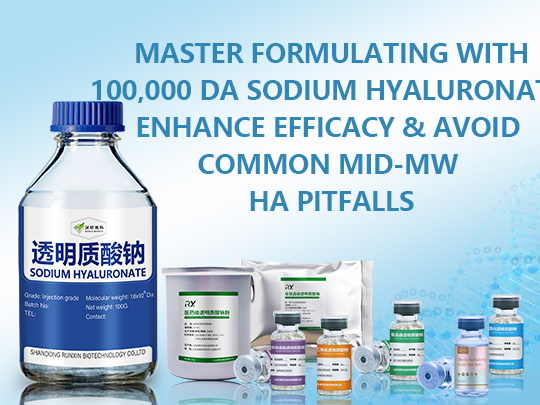
What Makes 100,000 Da Sodium Hyaluronate Special?
This mid-molecular-weight HA strikes an optimal balance between skin penetration and surface hydration, making it extremely versatile for:
1.Hydrating serums, creams, and emulsions
2.Functional food and supplement formulations
3.Advanced topical biomaterials and gel-based products
4.Ophthalmic and nasal spray solutions
Frequent Challenges & Practical Remedies
1. Inconsistent Gelling or Viscosity Build-Up
❗ Issue: Unpredictable rheology or uneven texture in final products.
✅ Recommendation:
①Pre-disperse the powder in ethanol or glycerin for smoother integration.
②Hold mixing temperature between 15-25°C to prevent premature gelling.
③For clearer gels, allow hydration time of 45-60 minutes under mild stirring.
2. Limited Formulation Flexibility with Actives
❗ Issue: Reduced efficacy or compatibility when blending with certain charged compounds.
✅ Recommendation:
①Test ionic compatibility early in the R&D phase.
②Introduce chelating agents like EDTA to minimize metal ion effects.
③Consider buffer optimization to maintain pH stability near 6.5.
3. Sensitivity to Processing Conditions
❗ Issue: Viscosity loss or HA degradation under high-shear or high-temperature processing.
✅ Recommendation:
①Avoid prolonged high-shear mixing; use sweep-style impellers when possible.
②Incorporate thermal protectants such as sorbitol or trehalose.
③Perform post-process viscosity checks to ensure batch-to-batch uniformity.
4. Moisture Retention vs. Sensory Feel Trade-off
❗ Issue: Sticky or tacky finish in leave-on products despite good hydration.
✅ Recommendation:
①Blend with silk amino acids or low-MW silicones to improve skin feel.
②Use concentrations between 0.8%–1.5% for ideal balance of effect and elegance.
③Pair with volatile fluids or powders to mitigate residue.
Optimal Usage Across Industries
1.Cosmetics: Replenishing toners, moisturizing masks, non-sticky hand creams
2.Nutraceuticals: Stable gel-cap fillings, powdered health drink mixes
3.Pharma & Medical: Lubricating gels, mucosal protective formulations, sprayable biomaterials
4.R&D: Cell culture media, enzyme stabilization, tissue engineering scaffolds
Why Partner with Runxin?
�� Complete qualification certificates:FDA, Halal, cGMP, ISO 9001, ISO 22000, HACCP, ISO 13485, FSSC 22000, REACH, NFS,and COSMOS。
�� Support the use of molecular weight for the test, as this ensures the quality.
�� Customization for HALAL, KOSHER, and organic requirements (COSMOS)
�� Support customized production of different molecular weights and packaging specifications
Pro Tips for Flawless Integration
1.For products requiring sprayability: combine with a non-ionic surfactant to reduce surface tension.
2.In electrolyte-rich environments, use our chemically modified HA derivatives for improved stability.
Request samples and consult our technical team for assistance with challenging formulations.
Conclusion
100,000 Da Sodium Hyaluronate offers a unique profile for diverse applications, provided you adapt your formulation approach to its specific behavior. Understanding these nuances allows you to enhance product performance while avoiding costly reprocessing or stability issues.
Elevate your next product with precision-grade HA. Reach out to Runxin Bio-Tech for samples, technical data, and formulation guidance tailored to your needs.