Sodium Hyaluronate is the water-soluble sodium salt form of hyaluronic acid, widely recognized in pharmaceutical and skincare formulations for its exceptional water retention capabilities, deep dermal penetration, and ability to improve skin elasticity, tissue repair, and overall barrier function.
At a Glance
| Section | Summary |
| Sodium Hyaluronate for Different Skin Types | Sodium Hyaluronate provides versatile hydration suitable for dry, oily, sensitive, and aging skin types due to its non-comedogenic and non-irritating molecular properties. |
| Skin benefits of sodium hyaluronate | This compound delivers profound skin benefits, including deep multi-layer hydration, enhancement of structural skin elasticity, and accelerated tissue regeneration. |
| Sodium Hyaluronate in Skin Care Products | Formulated across various cosmetic and pharmaceutical applications, Sodium Hyaluronate performance depends on specific molecular weight distributions and concentration purity. |
| Sodium Hyaluronate vs Hyaluronic Acid | While sharing identical biological target mechanisms, Sodium Hyaluronate offers superior stability, higher bioavailability, and greater cutaneous absorption compared to pure Hyaluronic Acid. |
| Common Misconceptions About Sodium Hyaluronate | Key industry misunderstandings regarding humidity-dependent moisture extraction, molecular size efficacy, and synthetic profile are addressed with technical chemical facts. |
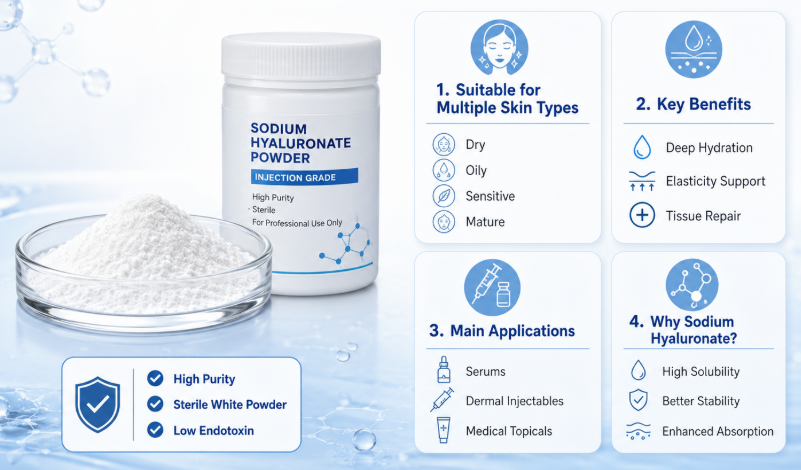
Sodium Hyaluronate for Different Skin Types
Sodium Hyaluronate acts as an adaptable, universal humectant that optimizes cutaneous hydration equilibrium across dry, oily, acne-prone, sensitive, and mature skin phenotypes without altering natural lipid barrier balance.
When evaluating physiological compatibility across diverse skin conditions, the molecular mechanism of Sodium Hyaluronate proves uniquely advantageous. Unlike heavy occlusive agents or aggressive emulsifiers, Injection Grade Sodium Hyaluronate Powder provides non-comedogenic hydration by binding atmospheric and endogeneous moisture directly within the extracellular matrix of the dermis and epidermis. For dry and dehydrated skin profiles, it restores essential fluid volume to compromised stratum corneum layers. Conversely, for oily and acne-prone skin types, it delivers non-lipid moisture that balances sebum overproduction caused by dehydration-induced rebound effects.
In sensitive and micro-damaged skin conditions, high-purity raw materials derived from microbial fermentation eliminate pyrogenic impurities and protein residue, preventing contact inflammatory reactions. Mature skin profiles benefit from sustained fluid retention in the dermal matrix, which temporarily plumps fine lines caused by transepidermal water loss. The physical viscosity and osmotic balance provided by specific molecular weights ensure that different skin types receive tailored physiological benefits without risk of pore occlusion or tissue irritation.
From a structural perspective, selecting the correct material purity and molecular weight profile is critical when engineering formulas for diverse dermatological needs. The following table highlights the functional interaction of Injection Grade Sodium Hyaluronate Powder across primary skin conditions:
| Skin Type Classification | Physiological Challenge | Primary Mechanism of Action | Recommended Molecular Weight Range |
| Dry / Dehydrated | Deficient intracellular water content and barrier damage | Binds up to 1000 times its weight in water, restoring intercellular lipid structure | High to Medium MW (1.0 MDa - 1.8 MDa) |
| Oily / Acne-Prone | Sebum hypersecretion and risk of pore blockage | Delivers weightless hydration without adding exogenic lipids or occlusive films | Low to Oligo MW (under 100k Da) |
| Sensitive / Reactive | Compromised epidermal barrier and low tolerance to impurities | Provides non-pyrogenic fluid retention while soothing micro-inflammation | High MW Ultra-Pure Injection Grade |
| Mature / Senescent | Dermal matrix collapse and structural elasticity depletion | Depresses transepidermal water loss and supports native collagen architecture | Mixed MW Spectrum (Broad distribution) |
Formulation Stability Note: To maintain optimal viscoelastic balance and prevent viscosity degradation in aqueous solutions containing high-purity polymers, formulators should strictly maintain pH levels between 5.5 and 7.5 while avoiding exposure to strong oxidizing agents or direct cationic surfactants.
Skin benefits of sodium hyaluronate
The clinical benefits of Sodium Hyaluronate center on its remarkable hygroscopic capacity, structural reinforcement of the dermal extracellular matrix, acceleration of tissue repair, and mitigation of age-related moisture loss.
As a vital glycosaminoglycan constituent of human connective tissue, Sodium Hyaluronate plays a direct bio-mechanical role in maintaining cellular hydration and tissue homeostasis. When applied topically or introduced via dermatological formulations, it forms a cohesive, viscoelastic network over and within skin layers. This network locks in aqueous fluid, reinforces the structural framework around collagen and elastin fibrils, and promotes an optimal physiological environment for cellular renewal. The biological efficacy of the polymer depends directly on parameter controls such as purity, endotoxin concentration, and precise molecular weight control during raw material synthesis.
Because skin degradation accelerates under environmental stressors such as ultraviolet radiation and metabolic aging, the continuous replenishment of pure, biocompatible sodium hyaluronate becomes necessary. Utilizing low-endotoxin, high-purity raw inputs ensures that skin cells experience enhanced hydric retention without triggering sub-clinical immune triggers or oxidative stress pathways.
Deep hydration
Deep hydration is achieved through the rapid penetration of lower molecular weight Sodium Hyaluronate fractions into deeper epidermal layers alongside surface film-forming high molecular weight fractions.
Unlike standard moisture-binding molecules, Injection Grade Sodium Hyaluronate Powder exhibits dual-action hydration dynamics. High molecular weight polymers reside on the stratum corneum surface to establish a protective, breathable hydrated layer that slows down transepidermal water loss. Concurrently, hydrolyzed or low molecular weight fragments traverse intercellular junctions into the lower epidermis, drawing water into deeper dermal strata.
This dual-layer hydric reservoir effect ensures that water retention is sustained over prolonged periods rather than evaporating quickly. By stabilizing intracellular fluid balance, the skin maintains optimal turgor pressure, smoother surface texture, and enhanced resistance against external environmental pollutants.
Improves skin elasticity
Skin elasticity improves as Sodium Hyaluronate inflates the extracellular matrix, offering biomechanical support that cushions structural proteins like collagen and elastin.
The loss of cutaneous elasticity is fundamentally linked to the depletion of interstitial fluid within the dermal extracellular matrix. High-purity Injection Grade Sodium Hyaluronate Powder provides the exact molecular backbone required to absorb free water molecules and swell into a firm hydrated gel matrix within tissue structures.
This internal swelling pressure outward lifts sunken tissue, reduces the visibility of fine expression lines, and improves tactile skin firmness. Furthermore, maintaining a fully hydrated extracellular space promotes proper nutrient exchange among fibroblasts, indirectly supporting native collagen synthesis and long-term tissue elasticity.
| Parameter Indicator | High Molecular Weight (HMW) | Medium Molecular Weight (MMW) | Low Molecular Weight (LMW) |
| Average Daltons (Da) | > 1.5 - 2.0 Million Da | 0.8 - 1.5 Million Da | < 100,000 Da |
| Primary Penetration Layer | Stratum Corneum (Surface) | Upper Epidermis | Deep Epidermis / Dermis |
| Viscosity Characteristics | High Viscosity / Strong Film | Medium Viscosity / Hydrating | Low Viscosity / Fluid |
| Primary Function | Trans-Epidermal Water Loss Barrier | Moisture Retention & Smoothness | Cellular Repair & Deep Hydration |
Sodium Hyaluronate in Skin Care Products
Sodium Hyaluronate serves as an essential functional active in serums, creams, dermal injectables, and medical-grade topical formulations due to its reliable solubility and rheological stability.
In contemporary dermatological and cosmetic science, the raw material grade of sodium hyaluronate directly determines final product safety, shelf-life, and biological performance. Industrial and cosmetic formulations range from daily hydrating serums to advanced sterile bio-revitalizers. High-grade purity profiles, such as those compliant with European Pharmacopoeia (Ph. Eur.) and USP standards, are vital when designing products meant for invasive delivery, micro-needling, or post-procedure barrier restoration where zero tissue inflammation is required.
Processing pharmaceutical-grade raw materials requires stringent fermentation protocols utilizing non-animal Streptococcus zooepidemicus strains followed by advanced alcohol precipitation and ultrafiltration steps. Choosing high purity pharmaceutical grade sodium hyaluronate ensures that trace heavy metals, protein residues, and bacterial endotoxins remain well below strict international safety thresholds (e.g., endotoxins < 0.005 IU/mg), guaranteeing maximum safety and stability across complex formulations.
| Quality Standard Parameter | Cosmetic Grade Requirements | Pharmaceutical / Injection Grade Standards |
| Bacterial Endotoxins | Not Strictly Quantified | < 0.005 IU/mg (Strict Control) |
| Protein Content | ≤ 0.1% | ≤ 0.01% |
| Nucleic Acid Content | ≤ 0.5% | ≤ 0.002% (Absorbance at 257nm < 0.5) |
| Heavy Metal Impurities | ≤ 20 ppm | ≤ 10 ppm |
| Appearance & Form | White Powder / Granules | Fine White Sterile Powder |
Sodium Hyaluronate vs Hyaluronic Acid
Sodium Hyaluronate is the sodium salt derivative of Hyaluronic Acid, offering superior physical stability, enhanced oxidation resistance, smaller molecular footprint possibilities, and significantly higher water solubility.
While the terms are often used interchangeably in marketing literature, clear chemical and structural distinctions exist between pure Hyaluronic Acid (HA) and Sodium Hyaluronate (SH). In its native acid form, Hyaluronic Acid is inherently unstable, prone to rapid thermal and oxidative degradation, and possesses low water solubility in neutral solutions. By converting the molecule into a sodium salt via controlled neutralization during manufacturing, the chemical structure becomes stabilized, highly hydrophilic, and less susceptible to environmental degradation.
From a manufacturing perspective, pure Hyaluronic Acid is difficult to incorporate stably into long-shelf-life cosmetic or medical formulations. Sodium Hyaluronate, by contrast, dissolves easily in aqueous media, creating clear, aesthetically pleasing, non-tacky solutions with controlled rheological properties. Additionally, the salt form permits precise molecular engineering, allowing raw material producers to yield precise molecular weight ranges tailored for targeted dermal delivery.
| Structural / Functional Feature | Hyaluronic Acid (Native Acid Form) | Sodium Hyaluronate (Salt Form) |
| Chemical Formula | (C14H21NO11)n | (C14H20NNaO11)n |
| Water Solubility | Low at Neutral pH | High / Instantaneous Dissolution |
| Chemical Stability | Moderate / Vulnerable to Oxidation | High Thermal and pH Stability |
| Tissue Penetration Efficiency | Low (Primarily Surface Bound) | High (Engineered MW Range) |
| Industrial Processing Ease | Challenging / High Precipitation Risk | Excellent / Uniform Dispersion |
Common Misconceptions About Sodium Hyaluronate
Common misconceptions regarding Sodium Hyaluronate involve claims that it extracts water from deep tissue in dry climates, functions as a synthetic chemical irritant, or operates identically regardless of raw material quality.
A persistent myth in skincare literature claims that humectants like Sodium Hyaluronate will reverse-hydrate and dry out lower skin layers if environmental humidity drops below certain levels. In practice, modern formulations combine Sodium Hyaluronate with complementary emollients, lipid barrier repair agents, and occlusives, preventing moisture loss regardless of ambient relative humidity. The molecule acts as a dynamic water reservoir, sharing hydration bi-directionally throughout the cutaneous layers.
Another widespread misconception is that all sodium hyaluronate raw materials yield equivalent clinical outcomes. In reality, raw materials vary significantly in terms of endotoxin loads, heavy metal residues, polydispersity indices, and bio-fermentation origins. Utilizing premium raw pharmaceutical grade sodium hyaluronate ensures predictable viscoelasticity, zero immune activation, consistent cellular response, and reliable technical performance across both cosmetic and medical application contexts.
Operational Handling Protocols: To prevent shear stress degradation of high molecular weight sodium hyaluronate chains during large-scale manufacturing, raw powders should be slowly hydrated under low-shear mechanical stirring at ambient temperatures prior to high-temperature thermal processing.
Conclusion
In summary, Sodium Hyaluronate remains an irreplaceable biopolymer within modern skincare and medical dermatological science. Its unparalleled water retention capability, biocompatibility across all skin phenotypes, and structural support of the extracellular matrix make it a cornerstone active ingredient. By understanding the critical differences between native hyaluronic acid and stable sodium hyaluronate salts, and recognizing the functional importance of purity levels and molecular weight selection, formulators can engineer advanced, highly effective solutions that deliver long-lasting skin hydration, improved elasticity, and enhanced tissue health.