Food Grade Sodium Hyaluronate Powder is a highly bioavailable, fermentatively derived polysaccharide that serves as a cornerstone ingredient in joint health supplements, nutricosmetics, and functional foods due to its exceptional capacity to retain moisture, lubricate synovial joints, and support the viscoelastic matrix of connective tissues. Understanding the technical nuances, regulatory benchmarks, molecular weight variations, and specific therapeutic applications of this powerful biopolymer is essential for brands looking to develop market-leading formulations. This comprehensive guide delivers an exhaustive analysis of the scientific, logistical, and commercial dimensions of integrating premium food-grade hyaluronic acid into modern health products, ensuring your brand meets both consumer expectations and rigorous global regulatory standards.
Article Outline and Section Summaries
| Section (H2 Title) | Summary |
| Description of Food Grade hyaluronic acid Powder | An exhaustive overview of the chemical structure, biological role, and advanced microbial fermentation production methods of food-grade sodium hyaluronate. |
| Technical Specifications & Quality Standards | A detailed technical breakdown of industry benchmarks, compliance standards, assay percentages, and molecular weight distributions essential for B2B procurement. |
| Benefits of Food Grade Sodium Hyaluronate | A deep dive into the scientifically proven health benefits of oral sodium hyaluronate, focusing on joint lubrication, cartilage preservation, and systemic skin hydration. |
| Application of Food Grade hyaluronic acid | A practical exploration of how to formulate with this powder across diverse product categories, including capsules, tablets, functional beverages, and nutricosmetics. |
| Food Grade hyaluronic acid Reference | A professional synthesis of regulatory frameworks, global market approvals, safety profiles, and dosage guidelines required for compliant product development. |
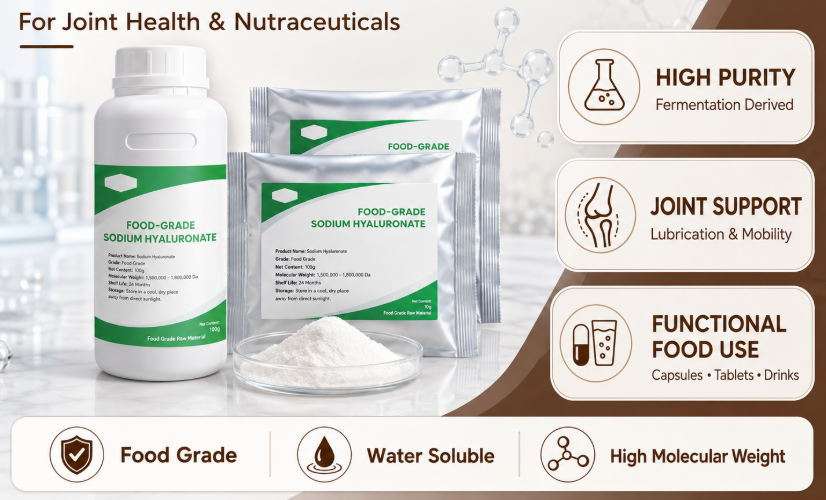
Description of Food Grade hyaluronic acid Powder
Food Grade Sodium Hyaluronate Powder is a high-purity, water-soluble sodium salt of hyaluronic acid produced via controlled microbial fermentation, specifically structured as a linear polysaccharide composed of repeating disaccharide units of D-glucuronic acid and N-acetyl-D-glucosamine.
Chemical Structure and Native Biological Role
Hyaluronic acid is a naturally occurring glycosaminoglycan distributed widely throughout mammalian extracellular matrices, with the highest concentrations found in synovial fluid, vitreous humor, and the dermal layers of the skin. In its native state, the molecule acts as a primary structural element, possessing an unparalleled capacity to bind and retain water molecules up to one thousand times its own physical weight. When isolated as Food Grade Sodium Hyaluronate Powder, the substance presents as a fine, white, odorless, and tasteless powder that dissolves completely in aqueous solutions to form highly viscous, non-Newtonian fluids. This molecular architecture allows it to function simultaneously as a shock absorber and a metabolic transport medium within biological systems.
The Evolution of Microbial Fermentation Production
Historically, hyaluronic acid was extracted primarily from avian sources, specifically rooster combs, which presented significant limitations regarding scalability, viral cross-contamination risks, and non-vegan compliance. Modern industrial manufacturing has completely transitioned to advanced microbial fermentation, typically utilizing non-pathogenic strains of Streptococcus zooepidemicus or engineered Bacillus subtilis. The microorganisms are cultured in strictly monitored bioreactors filled with plant-derived nutrient mediums containing glucose, peptone, and essential trace elements. During the exponential growth phase, the bacteria secrete high-molecular-weight hyaluronic acid as an extracellular capsule, which is subsequently isolated and refined.
Advanced Downstream Processing and Purification
Once the fermentation cycle reaches optimal yields, the broth undergoes a series of sophisticated separation and purification protocols to yield premium Food Grade Sodium Hyaluronate Powder. The biomass is first separated via microfiltration, followed by multi-stage ultrafiltration to remove residual bacterial proteins, nucleic acids, and endotoxins. The purified polysaccharide chain is then precipitated using organic solvents like ethanol or isopropanol, washed repeatedly, vacuum-dried, and milled under strict current Good Manufacturing Practice (cGMP) conditions. This rigorous downstream processing ensures that the final food-grade material maintains an exceptionally high assay level, a stable pH range, and a controlled microbiological profile suitable for direct human consumption.
[Microbial Fermentation] ➔ [Microfiltration (Biomass Removal)] ➔ [Ultrafiltration (Purification)] ➔ [Solvent Precipitation] ➔ [Vacuum Drying & Milling] ➔ [Final Food Grade Powder]
Technical Specifications & Quality Standards
The technical specifications and quality standards for Food Grade Sodium Hyaluronate Powder dictate its purity, safety, molecular weight distribution, and overall performance, requiring strict alignment with global pharmacopeias and food safety certifications.
Critical Analytical Parameters and Purity Metrics
When sourcing raw materials for commercial nutraceutical manufacturing, compliance with precise technical data sheets is non-negotiable to guarantee batch-to-batch consistency and consumer safety. High-grade Food Grade Sodium Hyaluronate Powder must feature a sodium hyaluronate content of no less than 90.0%, though premium manufacturers frequently deliver purity levels exceeding 95.0% on a dry basis. Analytical parameters must also strictly control for moisture content, heavy metal contamination, and residual protein levels, as these factors directly influence the physical stability, shelf life, and allergen profile of the finished dietary supplement.
Molecular Weight Categorization and Functionality
The physical properties and physiological pathways of ingested hyaluronic acid are heavily dependent on its molecular weight, which is measured in Daltons (Da) or kiloDaltons (kDa). For comprehensive product development, formulation scientists typically categorize the raw material into three primary weight ranges, each offering unique viscosity characteristics and biological mechanisms:
Technical Data Specification Framework
To assist procurement officers and quality assurance teams in evaluating raw materials, the following comparative matrix outlines the essential technical benchmarks required for compliant, premium-tier functional food formulations:
| Specification Parameter | Standard Requirement Range | Analytical Method Used |
| Appearance | White or almost white powder/granules | Visual Inspection |
| Sodium Hyaluronate Assay | 90.0% to 105.0% (Dry Basis) | Spectrophotometry (UV-Vis) / HPLC |
| Glucuronic Acid Content | Minimum 44.0% | Carbazole Assay |
| Molecular Weight Range | 10 kDa to 3,000 kDa (Customized) | Intrinsic Viscosity / SEC-MALS |
| pH Value (0.1% Aqueous Solution) | 6.0 to 7.5 | Potentiometric pH Meter |
| Loss on Drying | Maximum 10.0% | Gravimetric Oven Drying |
| Heavy Metals (as Pb) | Less than 10.0 ppm | Atomic Absorption / ICP-MS |
| Arsenic (As) | Less than 2.0 ppm | ICP-MS |
| Total Plate Count | Less than 1,000 cfu/g | Microbial Culture |
| Yeast and Molds | Less than 100 cfu/g | Microbial Culture |
| E. coli and Salmonella | Negative per gram / 25 grams | Selective Media Culturing |
Verification of International Quality Certifications
Beyond the basic chemical parameters, premium-tier ingredients must be backed by a robust portfolio of international quality system certifications. This includes compliance with ISO 9001 for quality management systems, ISO 22000 or FSSC 22000 for comprehensive food safety management, and rigorous Kosher and Halal verifications to satisfy diverse global consumer demographics. Furthermore, ensuring the manufacturing site follows established dietary supplement cGMP guidelines prevents cross-contamination and guarantees that the Food Grade Sodium Hyaluronate Powder remains free from unauthorized genetically modified organisms (GMOs), irradiation, and common allergens. Buyers seeking established manufacturing credentials can review the Food Grade 1000kDa Sodium Hyaluronate by Runxin 28 Years Manufacturing Global Supply to evaluate industrial-scale documentation.
Benefits of Food Grade Sodium Hyaluronate
The physiological benefits of Food Grade Sodium Hyaluronate Powder center on its scientifically proven ability to restore joint lubrication, alleviate arthritic discomfort, reduce systemic inflammation, and boost dermal moisture retention via regular oral supplementation.
Systemic Joint Lubrication and Synovial Fluid Enhancements
The primary therapeutic value of oral Food Grade Sodium Hyaluronate Powder lies in its direct impact on joint homeostasis and mechanical functionality. Within the diarthrodial joints, synovial fluid serves as a vital lubricant and shock absorber, preventing direct friction between articulating bone structures. In conditions like osteoarthritis or during periods of intense physical exertion, the endogenous concentration and molecular weight of hyaluronic acid drop significantly, leading to joint pain, stiffness, and localized degradation. Regular oral ingestion delivers critical polysaccharide precursors to the joint capsule, stimulating endogenous synoviocytes to synthesize fresh, high-molecular-weight hyaluronic acid, thereby restoring the fluid's necessary viscoelastic properties.
[Oral Ingestion of HA Powder] ➔ [Gastrointestinal Absorption via Lymphatic System] ➔ [Systemic Distribution to Joint Capsules] ➔ [Stimulation of Endogenous Synoviocytes] ➔ [Restored Synovial Fluid Viscosity & Reduced Friction]
Cartilage Matrix Preservation and Protection
Beyond basic surface lubrication, ingested sodium hyaluronate interacts directly with specific cell-surface receptors, most notably CD44, located on articular chondrocytes. This biological binding triggers an intracellular signaling cascade that helps downregulate the expression of pro-inflammatory cytokines, such as interleukin-1 beta (IL-1β) and tumor necrosis factor-alpha (TNF-α). Concurrently, this pathway suppresses the production of matrix metalloproteinases (MMPs), which are the primary enzymes responsible for breaking down the extracellular cartilage matrix. By inhibiting these destructive enzymatic pathways, the ingredient actively preserves the structural integrity of joint cartilage, delaying the progression of degenerative joint conditions.
Systemic Dermal Hydration and Anti-Aging Mechanics
While highly regarded for joint care, Food Grade Sodium Hyaluronate Powder functions as a highly effective nutricosmetic ingredient, delivering profound systemic hydration directly to the skin tissue. Topical skincare products are structurally limited by the skin barrier, often failing to penetrate deep into the dermal layers where true structural aging occurs. Oral supplementation overcomes this barrier by absorbing through the intestinal mucosa, traveling via the lymphatic system, and distributing throughout the deeper dermis. This systemic delivery boosts the moisture-binding capacity of the skin matrix, leading to measurable improvements in total skin elasticity, deep wrinkle reduction, and overall epidermal smoothness.
Key Health and Physiological Benefits
To provide a structured summary of how this biomolecule impacts human physiology, the primary benefits are detailed below:
Restoration of Synovial Fluid Rheology: Increases the density and viscosity of the lubricating fluid within joint cavities, preventing painful friction and supporting smoother movement.
Mitigation of Mechanical Joint Pain: Clinical studies indicate that consistent daily ingestion helps reduce chronic joint discomfort associated with early-stage osteoarthritis and cartilage wear.
Suppression of Pro-Inflammatory Mediators: Works at a cellular level to inhibit cytokines and enzymes that degrade cartilage, supporting long-term structural integrity.
Deep Dermal Moisture Retention: Replenishes the body's natural internal water reservoirs, leading to highly efficient, full-body skin hydration and anti-aging benefits.
Accelerated Tissue Repair Pathways: Supports the natural migration and proliferation of structural cells, aiding in recovery from minor joint stress or intensive exercise.
Application of Food Grade hyaluronic acid
The commercial applications of Food Grade Sodium Hyaluronate Powder span multiple consumer product sectors, including traditional dietary supplement capsules, compressed tablets, functional sports drinks, clear liquid wellness shots, and advanced nutricosmetic formulations.
Formulation Strategies for Solid Dosage Forms
In the traditional nutraceutical sector, incorporating Food Grade Sodium Hyaluronate Powder into solid oral dosage forms like hard gelatin or vegetable capsules and compressed tablets requires precise physical blending. Because the fine powder is naturally hygroscopic, formulators must combine it with appropriate free-flowing excipients, such as microcrystalline cellulose, magnesium stearate, or silicon dioxide, to avoid clumping and ensure uniform filling during high-speed manufacturing. The ingredient is exceptionally stable under standard pressing conditions, allowing it to be easily combined with other joint-health favorites like glucosamine sulfate, chondroitin sulfate, methylsulfonylmethane (MSM), and type II native collagen for comprehensive, multi-action joint support products.
Technical Integration into Functional Beverages and Liquids
One of the fastest-growing market segments is functional beverages, where the excellent water solubility of food-grade sodium hyaluronate provides a distinct advantage over insoluble alternatives. When formulating clear liquid shots, ready-to-drink (RTD) sports formulations, or liquid wellness drops, processing engineers must account for the natural viscosity increase that occurs when high-molecular-weight polymers dissolve. To achieve a smooth, light texture without creating a heavy or slimy mouthfeel, formulators often utilize low-to-medium molecular weight variants. The material maintains excellent stability across a broad pH spectrum, making it highly compatible with pasteurization techniques and hot-fill bottling lines, provided the thermal processing times are carefully regulated.
[Raw Ingredient Blending] ➔ [Excipient Stabilization] ➔ [Granulation / Liquefaction] ➔ [Dosage Packaging (Capsule/Liquid/Gummy)] ➔ [Quality Assurance Testing]
Innovative Applications in Functional Foods and Nutricosmetics
Beyond simple capsules and beverages, the modern functional food landscape is seeing widespread adoption of Food Grade Sodium Hyaluronate Powder in innovative consumer formats, such as enriched wellness gummies, fortified fruit jellies, and powder meal replacements. In these applications, the ingredient provides both functional health benefits and helpful texturizing properties, acting as a natural stabilizer and thickening agent. In the nutricosmetics space, it is frequently combined with hydrolyzed collagen peptides, biotin, vitamin C, and coenzyme Q10 to create targeted products aimed at health-conscious consumers looking to support both joint flexibility and skin youthfulness simultaneously. Brands exploring premium sourcing options for these diverse formulations can review the certified manufacturing standards available at Food Grade Sodium Hyaluronate Powder Runxin Certified Quality Supply.
Primary Commercial Product Applications
For product development teams exploring market opportunities, the matrix below details the primary commercial application formats along with their specific technical considerations:
Hard Capsules and Pressed Tablets: Frequently combined with glucosamine and chondroitin; requires anti-caking excipients to manage the powder's natural hygroscopic properties.
Ready-to-Drink Functional Sports Beverages: Requires low-to-medium molecular weight profiles to deliver effective joint support while maintaining a clean, pleasant mouthfeel.
Nutricosmetic Liquid Wellness Shots: Often paired with hydrolyzed collagen and essential vitamins to target skin density and elasticity from within.
Nutraceutical Gummy Supplements: Needs precise temperature controls during the pectin or gelatin cooking phase to prevent thermal degradation of the polysaccharide chains.
Dry Powder Supplement Drink Mixes: Utilizes customized agglomerated or granular forms of sodium hyaluronate to ensure fast, lump-free dissolution for the end consumer.
Food Grade hyaluronic acid Reference
Regulatory frameworks, clinical safety references, and verified toxicology profiles establish that Food Grade Sodium Hyaluronate Powder is universally recognized as safe for human consumption when formulated within standard daily therapeutic ranges.
Global Regulatory Status and Market Compliances
Navigating the complex global regulatory landscape is a vital step for brands bringing functional foods and dietary supplements to international markets. In the United States, high-purity Food Grade Sodium Hyaluronate Powder produced via microbial fermentation holds Self-Affirmed Generally Recognized as Safe (GRAS) status, allowing its use across a broad range of conventional food and beverage products. In the European Union, it is strictly governed under the Novel Food Regulation (EU) 2015/2283, which establishes specific purity parameters and approved food categories. Similarly, regulatory authorities in nations such as China, Japan, and South Korea have official monographs confirming its safety, making it a highly viable ingredient for global product distribution.
Clinical Dosage Guidance and Efficacy References
Scientific consensus derived from human clinical trials indicates that the effective daily dose of oral sodium hyaluronate ranges between 80 mg and 240 mg, depending on the targeted health outcome. For joint health and the management of osteoarthritic knee discomfort, multi-center, double-blind, placebo-controlled trials demonstrate that a daily intake of 120 mg to 200 mg for a minimum of eight consecutive weeks leads to significant improvements in standard Western Ontario and McMaster Universities Osteoarthritis Index (WOMAC) scores. For nutricosmetic applications focused primarily on skin hydration, clinical data shows that lower daily dosages of 120 mg are sufficient to produce measurable increases in stratum corneum moisture content and skin elasticity.
Comprehensive Regulatory and Dosage Matrix
To provide product formulators and regulatory compliance teams with a clear roadmap, the following reference table summarizes the globally accepted usage guidelines and safety parameters:
| Target Region | Regulatory Classification Status | Approved Maximum Daily Intake | Typical Product Category Focus |
| United States | Self-Affirmed GRAS / Dietary Supplement | Up to 240 mg / day recommended | Joint Capsules, Functional Beverages, Sports Nutrition |
| European Union | Approved Novel Food Ingredient | Max 200 mg / day in supplements | Nutricosmetics, Specialized Dietetic Foods |
| China | Approved New Food Raw Material | Maximum 200 mg / day | Functional Snacks, Gummy Candies, RTD Teas |
| Japan | Deemed Safe Food Ingredient / FFC | 120 mg to 240 mg / day | Beauty Supplements, Joint Care Powders |
| Global Markets | Kosher / Halal / Non-GMO Certified | Standardized by application | Universal Health & Wellness Formulations |
Safety Profiles and Toxicological Evaluations
Extensive toxicological evaluations, including acute oral toxicity studies, subchronic toxicity evaluations, and standard Ames mutagenicity tests, have consistently confirmed the excellent safety profile of fermentation-derived Food Grade Sodium Hyaluronate Powder. Because it is naturally bioidentical to the hyaluronic acid produced endogenously by the human body, oral consumption does not trigger adverse systemic immune reactions or gastrointestinal distress when consumed within recommended guidelines. Furthermore, the modern use of non-pathogenic, plant-based microbial fermentation eliminates the risks of avian-born pathogens or chemical extraction residues, ensuring a clean, stable, and highly sustainable ingredient source for the global wellness industry.