Sodium hyaluronate powder is categorized into five major purity and functional grades—Pharmaceutical Grade Sodium Hyaluronate Powder, Injection Grade Sodium Hyaluronate Powder, Eye Drop Grade Sodium Hyaluronate Powder, Cosmetic Grade Sodium Hyaluronate Powder, and Food Grade Sodium Hyaluronate Powder—to meet distinct safety, endotoxin, molecular weight, and regulatory compliance standards across global medical, cosmetic, and nutraceutical industries.
At a Glance
| Section | Summary |
| 1. Introduction to Sodium Hyaluronate Powder Grading | Overview of sodium hyaluronate biopolymer structure, molecular weight parameters, fermentation sourcing, and the essential regulatory necessity of strict industrial grade categorization. |
| 2. Pharmaceutical Grade Sodium Hyaluronate Powder Overview | Technical criteria for pharmaceutical-grade hyaluronan, detailing pharmacopeial monographs, purity standards, active pharmaceutical ingredient (API) uses, and quality control protocols. |
| 3. Injection Grade Sodium Hyaluronate Powder Technical Breakdown | Deep dive into Injection Grade Sodium Hyaluronate Powder specifications, viscoelastic behavior, sterile processing standards, bacterial endotoxin limits, and intradermal or intra-articular medical uses. |
| 4. Eye Drop Grade Sodium Hyaluronate Powder Characteristics | Exploration of ophthalmic grade requirements, ocular biocompatibility, shear-thinning tear retention mechanisms, and viscosity stability for eye drops and contact lens solutions. |
| 5. Cosmetic Grade Sodium Hyaluronate Powder Functionality | Analysis of cosmetic grade polymers across different molecular weight tiers (high, medium, low, oligo), multi-depth skin penetration, film-forming moisture locking, and formulation rules. |
| 6. Food Grade Sodium Hyaluronate Powder Applications | Examination of oral grade hyaluronan, intestinal bioavailability, systemic hydration mechanisms, heavy metal limits, and regulatory safety for nutricosmetic dietary supplements. |
| 7. Comparative Analysis Across All Sodium Hyaluronate Grades | Technical side-by-side comparative matrix contrasting purity, intrinsic viscosity, endotoxin limits, bioburden thresholds, manufacturing certifications, and primary applications across all five grades. |
| 8. Conclusion and Strategic Selection Parameters | Final technical synthesis, vendor selection check items, and procurement parameters for B2B formulators, regulatory managers, and product engineers. |
1. Introduction to Sodium Hyaluronate Powder Grading
Sodium hyaluronate powder represents the sodium salt form of hyaluronic acid, an endogenous glycosaminoglycan naturally occurring throughout human connective, epithelial, and neural tissues.
The chemical polymer consists of repeating disaccharide units of D-glucuronic acid and N-acetyl-D-glucosamine linked via alternating beta-1,4 and beta-1,3 glycosidic bonds. Due to its polyanionic character at physiological pH, sodium hyaluronate exhibits extraordinary water retention capacity, holding up to 1000 times its molecular mass in aqueous solutions. In industrial and B2B manufacturing, raw sodium hyaluronate is produced through advanced bacterial fermentation—primarily using non-pathogenic strains such as Streptococcus zooepidemicus—followed by extensive multi-stage purification, membrane filtration, ethanol precipitation, and controlled vacuum drying.
Because sodium hyaluronate is utilized across vastly different end-use sectors ranging from oral dietary supplements to invasive parenteral medical devices, establishing strict grade categorizations is paramount. The functional performance, safety profile, biocompatibility, and regulatory compliance of sodium hyaluronate depend heavily on parameters such as molecular weight (MW) distribution, intrinsic viscosity, chemical purity percentages, bacterial endotoxin limits, total heavy metal content, and microbiological bioburden. Applying an improper grade—such as using cosmetic grade material in an ophthalmic or injectable preparation—presents severe clinical safety risks including anaphylaxis, ocular inflammation, tissue toxicity, and sterile abscesses caused by trace bacterial endotoxins or cellular proteins.
Consequently, global pharmacopeias (such as EP, USP, JP, and ChP) and regulatory bodies enforce highly specific technical monographs for each raw material grade. Understanding these technical nuances allows formulation scientists, regulatory affairs managers, and commercial procurement teams to select the precise polymer grade that matches their manufacturing technology, target anatomical delivery route, and legal compliance landscape.
2. Pharmaceutical Grade Sodium Hyaluronate Powder Overview
Pharmaceutical grade sodium hyaluronate powder represents a highly purified, medical-standard biopolymer manufactured under stringent Good Manufacturing Practice (GMP) guidelines to meet global pharmacopeial monographs.
Pharmaceutical grade material is synthesized to ensure maximum physiological tolerance, biological activity, and chemical stability. Unlike cosmetic or food grades, pharmaceutical grade sodium hyaluronate must undergo multi-stage ultrafiltration, recrystallization, and ethanol purification processes to eliminate cellular debris, DNA fragments, residual proteins, and organic solvents. The purity level of pharmaceutical grade material consistently exceeds 95.0% to 99.0% on a dry basis, with extremely narrow molecular weight distributions tailored to specific therapeutic mechanisms.
In medical therapy, pharmaceutical grade hyaluronan serves as a primary active pharmaceutical ingredient (API) or essential functional excipient. Its therapeutic utility spans orthopedic viscosupplementation, surgical viscoelastic devices (OVDs), advanced wound healing matrices, topical dermatological gels, mucosal drug delivery systems, and controlled-release parenteral formulations. The intrinsic viscosity and rheological behavior of pharmaceutical grade hyaluronan can be customized to yield pseudo-plastic, viscoelastic gel networks that mimic physiological synovial fluid or natural extracellular matrices.
To ensure consistency across international pharmaceutical supply chains, global medical device and drug manufacturers rely on high-purity raw materials. For specialized medical and parenteral formulations, technical teams often evaluate high-purity options such as Injection Grade Sodium Hyaluronate Powder to meet stringent European and US pharmacopeial criteria.
| Parameter | Pharmacopeial Specification (EP / USP Standard) | Testing Method |
| Assay (Sodium Hyaluronate) | 95.0% – 105.0% (dry basis) | HPLC / UV-Vis Spectrophotometry |
| Appearance | White or almost white powder or fibrous aggregate | Visual Inspection |
| Intrinsic Viscosity | 1.5 – 3.5 m³/kg (customizable by MW) | Ubbelohde Viscometer (25°C) |
| Bacterial Endotoxins | < 0.05 EU/mg (or < 0.005 EU/mg for parenterals) | LAL (Limulus Amebocyte Lysate) Test |
| Protein Content | ≤ 0.1% | Bradford / Lowry Assay |
| Nucleic Acids (Absorbance at 260 nm) | A260 ≤ 0.5 | UV Spectrophotometry |
| Loss on Drying | ≤ 10.0% | Thermogravimetric Analysis / Vacuum Oven |
| Heavy Metals (as Pb) | ≤ 10 ppm / ≤ 20 ppm | ICP-MS / Atomic Absorption |
Pharmaceutical Quality Assurance Protocol: During the purification of pharmaceutical grade hyaluronan, column chromatography and membrane ultrafiltration must be continuously monitored for pyrogen clearance. Batch validation protocols require rigorous testing for residual solvents (such as ethanol or isopropanol used in precipitation) via headspace gas chromatography, ensuring levels remain well below ICH Q3C guidelines.
3. Injection Grade Sodium Hyaluronate Powder Technical Breakdown
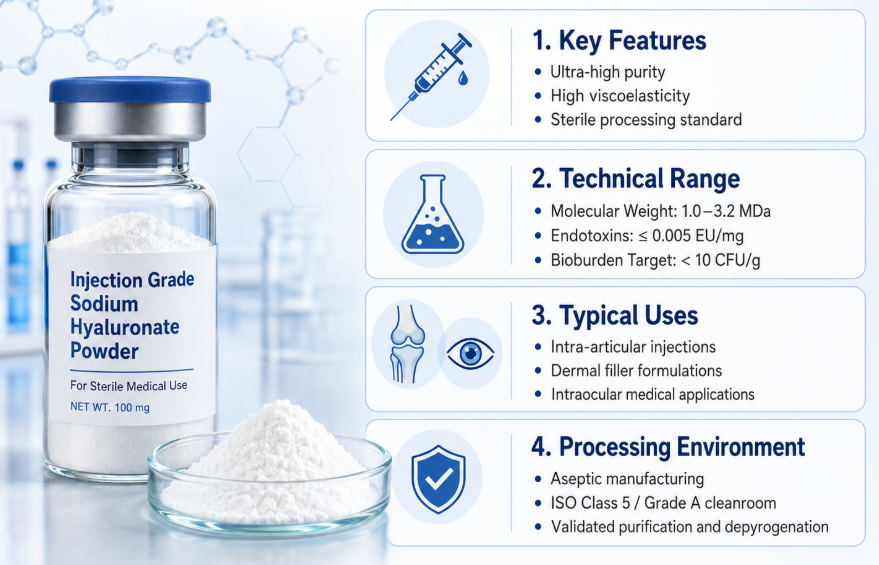
Injection Grade Sodium Hyaluronate Powder is the highest purity tier of sodium hyaluronate, specifically refined for parenteral administration, intra-articular joint injections, dermal fillers, and intraocular surgery.
Injectable applications demand uncompromising quality standards because the polymer bypasses the protective epidermal and mucosal barriers of the human body, directly entering subcutaneous tissue, synovial joint capsules, or the ocular anterior chamber. Consequently, Injection Grade Sodium Hyaluronate Powder must feature near-zero endotoxin levels (typically < 0.005 EU/mg), absolute sterility assurance, and total absence of pyrogenic or immunogenic contaminants. Bacterial endotoxins (lipopolysaccharides from Gram-negative bacterial cell walls) cause severe fever, acute intraocular inflammation (endophthalmitis), or joint effusion if present in parenteral products.
From a biomechanical perspective, injectable hyaluronan is characterized by its high molecular weight (typically ranging from 1.2 MDa to over 3.0 MDa) and robust viscoelastic properties. When formulated into intra-articular injections for osteoarthritis treatment, it restores the elastoviscosity of damaged synovial fluid, acting as a lubricant during slow shear stress and a shock absorber during high shear impact. In aesthetic medicine, cross-linked or non-cross-linked dermal fillers utilizing high MW Injection Grade Sodium Hyaluronate Powder provide structural dermal support, tissue augmentation, and long-lasting enzymatic degradation resistance against endogenous hyaluronidase.
Manufacturing injectable grade material requires aseptic processing environments conforming to ISO Class 5 (Grade A) cleanrooms, ultrafiltration units with precise molecular weight cut-off (MWCO) membranes, and validated heat or ethanol depyrogenation procedures. Commercial buyers evaluating reliable sourcing options focus heavily on verified Drug Master File (DMF) documentation, CEP certifications, and full compliance with European Pharmacopoeia monographs.
| Technical Attribute | Standard Specification Limit | Clinical Significance |
| Molecular Weight Range | 1.0 MDa – 3.2 MDa (High MW) | Dictates viscoelasticity, hydrodynamics, and tissue residence time |
| Bacterial Endotoxins | ≤ 0.005 EU/mg (Strict limit) | Prevents pyrogenic reactions, pain, and intra-articular/intraocular inflammation |
| Bioburden / Microbial Limits | < 10 CFU/g (Sterile grade target) | Ensures terminal sterilization or aseptic filtration feasibility |
| Kinematic Viscosity (1% sol) | 1000 – 6000 mPa·s | Determines extrudability through fine-gauge injection needles (27G–30G) |
| pH (1% aqueous solution) | 6.0 – 7.5 | Matches physiological pH to avoid local tissue necrosis or burning |
| Transmittance (1% sol at 550nm) | ≥ 99.0% | Guarantees optical clarity for clear dermal gels and ophthalmic surgery |
Injectable Processing and Sterilization Safeguards: High molecular weight sodium hyaluronate undergoes thermal degradation if subjected to standard autoclave steam sterilization (121°C for 20 minutes) in solution form. Therefore, primary raw material manufacturers utilize ultra-pure aseptic precipitation techniques combined with sterile dry powder handling or low-temperature sterile filtration of diluted intermediate solutions prior to sterile freeze-drying or sterile packaging.
4. Eye Drop Grade Sodium Hyaluronate Powder Characteristics
Eye Drop Grade Sodium Hyaluronate Powder is a specialized, ophthalmic-compliant biopolymer engineered specifically for topical ocular therapeutics, artificial tear solutions, and contact lens rewetting formulations.
The ocular surface is an exceptionally sensitive physiological environment governed by the corneal epithelium, conjunctival tissue, and precorneal tear film. Ophthalmic formulations require raw materials that provide non-irritating, long-lasting ocular surface hydration without causing visual blurring or corneal toxicity. Eye drop grade hyaluronan meets stringent purity criteria, maintaining low endotoxin levels (≤ 0.05 EU/mg or lower) and strictly controlled bioburden to ensure safety in multi-dose or preservative-free single-dose eye drop delivery devices.
The mechanism of action for eye drop grade sodium hyaluronate relies on its shear-thinning (pseudoplastic) rheological behavior. During the inter-blink interval, when shear rate is zero, the hyaluronan polymer chains form an entangled molecular network that increases tear film viscosity, stabilizes the lipid-mucin layer, and prevents tear evaporation. During a blink, high shear forces cause the polymer chains to align parallel to the direction of motion, rapidly reducing solution viscosity to allow smooth eyelid movement without sticky sensation or blurred vision. Furthermore, hyaluronan binds directly to CD44 receptors expressed on corneal epithelial cells, promoting corneal epithelial wound healing and cell migration.
Formulators select specific molecular weight ranges (typically 1.0 MDa to 2.0 MDa) for eye drop grade material to strike an optimal balance between retention time on the ocular surface and comfortable drop dispensing from squeeze bottles or automated ophthalmic filling lines.
| Key Parameter | Ophthalmic Standard Target | Functional Value in Ocular Care |
| Ophthalmic Purity | ≥ 98.0% Dry Basis | Minimizes chemical impurities that trigger conjunctival hyperemia |
| Bacterial Endotoxin | ≤ 0.05 EU/mg | Prevents anterior chamber toxic anterior segment syndrome (TASS) |
| Molecular Weight | 0.8 MDa – 2.2 MDa | Provides pseudoplastic shear-thinning for clear vision post-blinking |
| Clarity & Color of Solution | Clear, colorless (Absorbance at 430nm ≤ 0.01) | Ensures optical neutrality and transparency for eye drops |
| Chlorides & Sulfates | ≤ 0.5% Chlorides / ≤ 0.1% Sulfates | Maintains correct osmotic balance with physiological tears (290 mOsm/kg) |
Ophthalmic Rheology and Stability Considerations: When designing preservative-free eye drop formulations containing ophthalmic grade hyaluronan, the ionic strength and divalent cation concentration (such as Ca⊃2;⁺ and Mg⊃2;⁺) of the vehicle must be carefully calibrated. Excess electrolyte concentrations screen the negative charges on the hyaluronan carboxylate groups, reducing hydrodynamic volume and lowering solution viscosity.
5. Cosmetic Grade Sodium Hyaluronate Powder Functionality
Cosmetic Grade Sodium Hyaluronate Powder is a functional skincare and cosmetic ingredient processed to offer multi-depth dermal hydration, barrier repair, and anti-aging efficacy in topical cosmetic formulations.
In modern cosmetic chemistry, sodium hyaluronate is categorized into multiple molecular weight fractions, each offering unique biological and biophysical benefits when applied topically to the stratum corneum. Unlike single-grade raw materials, cosmetic formulations frequently blend high, medium, low, and micro (oligomeric) molecular weight hyaluronans to achieve 3D spatial hydration throughout different epidermal layers.
High Molecular Weight (> 1.5 MDa): Forms an elastic, breathable surface film on the stratum corneum, reducing Trans-Epidermal Water Loss (TEWL), protecting against environmental pollutants, and providing immediate surface smoothing.
Medium Molecular Weight (200 kDa – 1.0 MDa): Penetrates into the superficial epidermal layers, offering sustained moisture retention and improving skin elasticity.
Low Molecular Weight (10 kDa – 100 kDa): Deeply penetrates the epidermis, promoting cell-matrix interaction, supporting endogenous hyaluronic acid synthesis, and soothing irritated skin.
Oligo / Micro Sodium Hyaluronate (< 10 kDa): Enzymatically hydrolyzed ultra-low polymer that penetrates deep into the stratum spinosum and basale, triggering anti-aging signaling, boosting collagen expression, and accelerating epidermal repair.
| Molecular Weight Tier | Dalton Range (Da) | Primary Skin Penetration Depth | Core Cosmetic Functionality |
| High MW (HMW) | > 1.5 MDa | Stratum Corneum Surface | Film-forming, moisture locking, anti-pollution shield, TEWL reduction |
| Medium MW (MMW) | 200 kDa – 1.0 MDa | Outer Epidermis | Sustained hydration, skin softening, formulation thickening |
| Low MW (LMW) | 10 kDa – 100 kDa | Mid-Epidermis | Deep epidermal hydration, fine line plumping, elasticity boost |
| Oligo / Micro HA | < 10 kDa (Enzymatic) | Deep Epidermis / Basal Layer | Cellular repair, collagen boosting, anti-wrinkle signaling |
Cosmetic Formulation Stability Guidelines: Formulating with cosmetic grade sodium hyaluronate requires attention to system compatibility. High MW hyaluronan is sensitive to high shear homogenization, which can mechanically degrade polymer chains and reduce formulation viscosity. Additionally, cationic surfactants, quaternary ammonium preservatives (such as cetrimonium bromide), and cationic conditioning polymers can form insoluble coacervate precipitates with anionic hyaluronate molecules.
6. Food Grade Sodium Hyaluronate Powder Applications
Food Grade Sodium Hyaluronate Powder is a dietary supplement and functional food raw material specifically produced to support systemic body hydration, joint mobility, skin moisture from within, and mucosal health via oral ingestion.
Historically considered purely a topical or injectable biopolymer, scientific research over the past two decades has established that orally ingested sodium hyaluronate is effectively absorbed and distributed throughout peripheral tissues. Following ingestion, food grade hyaluronan is partially broken down by intestinal microbiota into oligosaccharides in the large intestine. These low molecular weight fragments are absorbed through intestinal epithelial cells, entering the lymphatic system and bloodstream. Furthermore, intestinal hyaluronan binds to Toll-like Receptor 4 (TLR4) in the gut mucosa, triggering systemic anti-inflammatory signaling cascades that downregulate pro-inflammatory cytokines in joint cartilage and skin dermal layers.
Nutricosmetics—the intersection of dietary supplements and personal care—represents the largest commercial driver for food grade sodium hyaluronate. Clinical studies demonstrate that daily oral supplementation of 120 mg to 200 mg of food grade hyaluronan over 4 to 8 weeks significantly increases skin hydration, reduces skin roughness, and improves joint lubrication in individuals suffering from early-stage osteoarthritis.
| Specification Category | Food Grade Standard Target | Regulatory & Safety Context |
| Assay (Sodium Hyaluronate) | ≥ 90.0% – 95.0% | Meets dietary supplement purity requirements |
| Molecular Weight Range | 0.5 MDa – 1.5 MDa (Standard oral MW) | Optimized for intestinal absorption and gut-microbiota fermentation |
| Heavy Metals (Pb, As, Hg, Cd) | Pb ≤ 2.0 ppm, As ≤ 1.0 ppm, Hg ≤ 0.1 ppm, Cd ≤ 1.0 ppm | Strict compliance with food safety and toxicological thresholds |
| Total Aerobic Microbial Count (TAMC) | ≤ 1000 CFU/g | Standard food safety limit for dry botanical/fermented powders |
| Total Combined Yeasts/Moulds Count (TYMC) | ≤ 100 CFU/g | Prevents fungal spoilage in dietary capsules, tablets, and beverages |
| Pathogens (E. coli, Salmonella, S. aureus) | Absent in 10g / 25g | Mandatory pathogen clearance for human consumption safety |
Oral Supplement Processing Principles: Food grade sodium hyaluronate powder exhibits high hygroscopicity. When manufacturing dietary capsules, direct compression tablets, or instant beverage premixes, production facilities must maintain relative humidity (RH) below 40% to prevent powder caking, clumping, or enzymatic degradation caused by ambient moisture absorption.
7. Comparative Analysis Across All Sodium Hyaluronate Grades
Selecting the correct sodium hyaluronate powder grade requires a structured evaluation of purity, endotoxin standards, molecular weight distribution, regulatory compliance, and target anatomical delivery routes.
To facilitate technical assessment and B2B procurement decision-making, the matrix below presents a comprehensive side-by-side comparison across all five commercial grades of sodium hyaluronate powder.
| Grade Category | Purity Assay | Endotoxin Limit | Bioburden Limit | Typical Molecular Weight | Primary Target Application |
| Pharmaceutical Grade | 95.0% – 105.0% | < 0.05 EU/mg | < 100 CFU/g | 0.5 MDa – 3.0 MDa | Viscosupplementation, wound dressings, API carrier gels |
| Injection Grade | 98.0% – 102.0% | ≤ 0.005 EU/mg | Sterile / < 10 CFU/g | 1.2 MDa – 3.2 MDa | Intra-articular injections, dermal fillers, intraocular devices |
| Eye Drop Grade | 98.0% – 102.0% | ≤ 0.05 EU/mg | < 10 CFU/g | 0.8 MDa – 2.2 MDa | Artificial tears, contact lens rewetting, ophthalmic drops |
| Cosmetic Grade | ≥ 91.0% – 95.0% | Not Standardized | < 100 CFU/g | 3 kDa – 2.5 MDa | Facial serums, moisturizing creams, anti-aging lotions |
| Food Grade | ≥ 90.0% – 95.0% | Not Standardized | < 1000 CFU/g | 0.5 MDa – 1.5 MDa | Nutricosmetic capsules, oral liquids, functional beverages |
Regulatory Compliance Verification: High-risk medical applications require full Drug Master File (DMF) registration, EDQM CEP certification, and ISO 13485 cleanroom validation. Lower-risk cosmetic and food applications focus on ISO 22716 (cGMP cosmetics), HALAL, KOSHER, and EFSA dietary novelty compliance.
Cost-Efficiency Optimization: Choosing parenteral or injection grade material for topical cosmetics or oral supplements introduces unnecessary raw material expenditure without offering functional benefits to the end user. Conversely, using lower grades in medical devices risks catastrophic batch rejections, adverse clinical events, and regulatory sanctions.
Viscosity and Rheological Alignment: High molecular weight polymers provide superior thickening and elastic shock absorption, whereas low molecular weight polymers deliver deeper tissue penetration, rapid dissolution, and lower solution viscosity for high-concentration liquid formulations.
8. Conclusion and Strategic Selection Parameters
Understanding the structural, technical, and regulatory differences across sodium hyaluronate powder grades is essential for optimizing product safety, formulation stability, and commercial success.
In summary, raw sodium hyaluronate powder is refined into highly specialized grades engineered for specific physiological interfaces and regulatory pathways. Injection Grade Sodium Hyaluronate Powder leads the purity spectrum with ultra-strict endotoxin controls for parenteral and intra-articular therapies. Eye Drop Grade balances viscosity and optical clarity for sensitive ocular care. Pharmaceutical Grade provides versatile bio-functional active ingredients for topical and systemic medical treatments. Cosmetic Grade delivers multi-depth epidermal hydration through tailored molecular weight blends, while Food Grade nourishes skin and joints from within through systemic bioavailability.
B2B procurement teams, R&D scientists, and regulatory officers must carefully evaluate vendor qualifications, certificate of analysis (CoA) parameters, batch-to-batch consistency, and international regulatory documentation (DMF, CEP, ISO) prior to raw material integration. By matching product specifications to exact application requirements, manufacturers can ensure maximum therapeutic efficacy, outstanding product performance, and full regulatory compliance across global markets.
Grade Selection Best Practices & Quality Control Tips: Always request comprehensive Certificates of Analysis (CoA) specifying molecular weight determination via Multi-Angle Laser Light Scattering (MALLS) or SEC-HPLC rather than simple viscosity estimation. For sterile parenteral and ophthalmic preparations, verify that raw material suppliers perform endotoxin testing using validated kinetic chromogenic LAL assays to prevent batch-to-batch variability.