Crosslinked hyaluronic acid gel is not simply hyaluronic acid made thicker. Once the hyaluronic acid molecules are crosslinked, the material state, internal structure, flow behavior and ability to retain its shape all change. When choosing this type of material, you need to confirm that its structure fits the intended product, processing method and quality requirements.
A practical assessment of crosslinked hyaluronic acid gel should cover four points: what it is, how it is made, which quality attributes may be affected by the manufacturing process, and how its suitability for the finished product will be verified.
1. What Is Crosslinked Hyaluronic Acid Gel?
Crosslinked hyaluronic acid gel is formed by creating links between hyaluronic acid chains through chemical or other appropriate methods. The molecular system, which would otherwise flow more readily, develops a more stable three-dimensional network. After crosslinking, the hyaluronic acid exists not only as dispersed molecules or entangled chains, but also as a material with a more defined gel state.
This structure can affect viscoelasticity, shape retention, recovery after mechanical stress and flow under different shear conditions. These changes should not be taken to mean that the material is automatically “better.” The final result depends on factors such as the degree of crosslinking, hyaluronic acid concentration, molecular characteristics, purification status and test conditions.

You also need to separate three concepts. “Crosslinked” describes the structural state; “medical grade” refers to a set of quality or application-related requirements; and suitability for a particular medical product must be confirmed through the specific formulation, process and finished-product validation. Crosslinked hyaluronic acid gel is not automatically tied to one medical use, and its clinical effect cannot be inferred from the material name alone.
2. What Raw Materials and Conditions Are Needed Before Crosslinking?
Before crosslinking, the basic condition of the hyaluronic acid raw material needs to be confirmed. This includes purity, molecular characteristics, concentration, dissolution state and batch information. If the raw material is not fully dissolved, evenly dispersed or sufficiently consistent from batch to batch, it may be difficult to form a uniform gel structure later in the process.
The reaction conditions also need to fit the intended product. Raw material concentration affects how the system can be handled, while the reaction environment affects how crosslinking proceeds. Temperature, reaction time, mixing conditions and subsequent processing can all influence gel uniformity. In practice, the result is not judged by one parameter alone; the raw material, process records and test results need to be reviewed together.
A passing result for one specification does not predict every aspect of the finished product. For example, raw material purity within specification does not guarantee that the crosslinked material will have the target viscosity. A clear-looking sample does not, by itself, confirm the internal structure or residual-material control. The preparation stage must ultimately be checked through gel testing and application testing.
3. How Is Crosslinked Hyaluronic Acid Gel Manufactured?
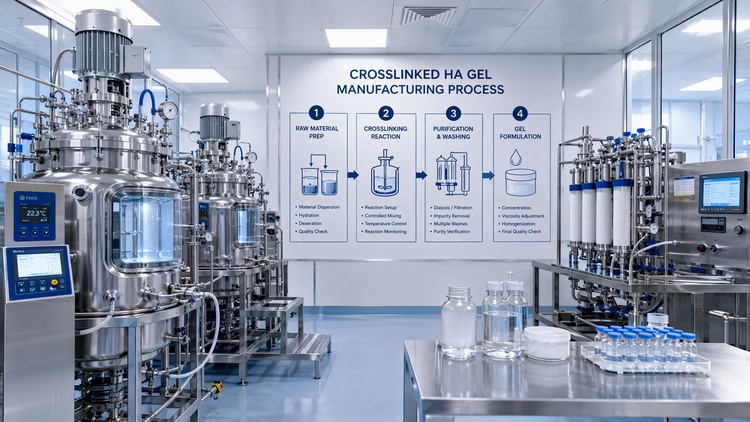
The manufacturing process can be understood as a series of connected stages. It starts with raw material preparation, including dissolution, dispersion and concentration confirmation, so that the hyaluronic acid reaches a suitable state for the reaction. The system then enters the crosslinking stage, where the molecular chains are connected under defined conditions.
After the reaction, the gel normally undergoes purification and washing to remove unreacted components, residual materials or processing media that should not remain in the product. The gel is then adjusted to meet the intended product requirements for concentration, water content, uniformity and flow behavior. Before filling or packaging, appearance, batch information, container compatibility and other relevant quality items are checked.

These stages are not interchangeable steps that can be applied without regard to the product. Different products have different requirements for gel state, packaging format, sterilization strategy and storage conditions, so the manufacturing process needs to be designed around the intended use. You do not need access to a confidential fixed formula, but you should be able to confirm that the process has defined controls, a clear purification approach and batch records.
4. Which Product Quality Attributes May Be Affected by Manufacturing?
Manufacturing can first affect gel uniformity. Insufficient or uneven crosslinking may cause different parts of the same batch to behave differently. Excessive processing or incomplete purification may affect the gel state, residual-material level and subsequent stability. Uniformity should be assessed through the sampling plan, test method and batch data rather than by looking at a small portion of the sample.
Viscosity and rheological behavior must also be compared under defined test conditions. Different concentrations, temperatures, shear rates and methods can produce different results. When comparing technical data, you should confirm the test method and its scope instead of comparing a single number in isolation.
Information on residual materials, microbial control and endotoxin is relevant to the next stage of product development, but the specific requirements depend on the intended use and regulatory pathway. The specification defines the control range; the COA reports the result for a particular batch; your sample testing shows how the material behaves in the actual process; and finished-product validation determines whether the final product meets its own requirements. These forms of information are not interchangeable.
Packaging materials, seal integrity and storage conditions may also affect the gel after delivery. You should include package compatibility, batch consistency and storage information in the review rather than drawing a conclusion from the appearance of the first sample alone.
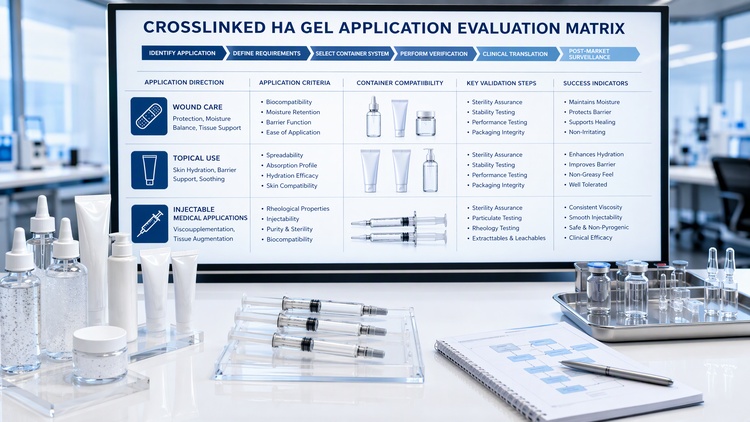
5. What Product Directions May Use Crosslinked Hyaluronic Acid Gel?
Crosslinked hyaluronic acid gel may be considered for wound-care products, topical use, injectable applications and other medical product development projects that require a gel structure. Its network structure may give it spreading, residence or stress-response characteristics that differ from those of a standard hyaluronic acid solution, but this is only the starting point for application assessment.
Wound-care products generally require attention to coating, coverage, package dispensing and storage. For topical products, you need to observe how the material spreads and remains on the intended surface. Injectable applications require additional review of injection force, particulate control, the container system, the sterilization strategy and the safety of the finished product. The focus is different for each application.
A product should not be considered suitable for every medical use simply because it is described as “medical grade.” The term usually refers to a quality or application-related description; it does not replace product-specific regulatory review, process validation, stability studies or clinical evaluation. Define the finished product and contact conditions first, then confirm the specifications and verification items required for that use.
6. How Can You Evaluate Whether Crosslinked Gel Fits Your Product?
Start with the intended use. Clarify whether the product is for wound care, topical use, an injectable application or another direction, and then decide whether the required material should be a powder, solution or gel. Next, review the key specifications, including concentration, viscosity or rheological data, structural information, purity, microbial control, endotoxin-related information, packaging and storage conditions.
The sample stage should reflect the actual production process as closely as possible. In addition to appearance, you can test dissolution, mixing, filling, injection, coating, extrusion or dispensing through the proposed container, depending on the product format. With a crosslinked gel, a static appearance is not enough to predict use behavior because stress, shear and temperature changes can alter how the material performs.
Finally, connect the sample results with the batch documents, specification range and finished-product testing. A good sample result does not mean that the finished product has been validated, and a passing raw-material test does not confirm that the package, sterilization method and final formulation will be compatible. A sound decision brings together the intended use, batch information, actual process and finished-product validation.
7. How Does Runxin Support Crosslinked Gel Application Evaluation?
Shandong Runxin Biotechnology Co., Ltd. is located in Qufu and integrates research and development, production and sales. The company has 28 years of production and export experience and provides OEM/ODM services. For crosslinked hyaluronic acid gel projects, Runxin can help you organize the early evaluation around the intended use, target material form, specification documents and sample communication.
When starting a discussion, you can describe the product you plan to develop, how it will be used, the target material state and the quality requirements already defined. You can then confirm the sample format, technical documents and tests that need to be reviewed. This is more useful than simply asking which gel is “the best,” because different products require different decisions about gel structure, viscosity, packaging and validation.
Runxin’s company and quality documents should be read within their stated scope. Certifications such as ISO9001, ISO22000, HALAL and HACCP can help you understand the relevant quality-management or production-system information, but they do not replace product-specific documents for a crosslinked medical gel project, finished-product approval or clinical evaluation. The project should still be assessed using the actual documents, sample testing and finished-product validation results.
Conclusion
Crosslinked hyaluronic acid gel should not be judged by the words “crosslinked” or “medical grade” alone. A more reliable approach is to review raw material preparation, the crosslinking reaction, purification and quality testing, then relate those findings to the intended product’s processing method, packaging conditions and finished-product validation. Only when the material information matches the application requirements can you decide whether the gel fits your product development.
Further Reading
The following articles provide additional information on sodium hyaluronate applications, grade classification and raw material forms:
Sodium Hyaluronate in Medical Applications: Grades, Forms and Uses
What Are the Different Grades of Hyaluronic Acid?
What Are the Benefits of Sodium Hyaluronate Powder?