Sodium hyaluronate is the salt form of hyaluronic acid, characterized by a lower molecular weight and enhanced water-solubility, making it an ideal ingredient for deep skin hydration, tissue repair, and therapeutic medical applications.
As global demand for effective, non-invasive skincare and advanced medical delivery systems grows, the reliance on high-purity premium-grade Sodium Hyaluronate Powder has never been greater. This guide explores the multifaceted nature of this compound, comparing its technical advantages against traditional hyaluronic acid, and mapping out its expansive role in both dermatology and clinical medicine.
Table of Contents
| Section | Summary |
| What is Sodium Hyaluronate? | Defines the compound as a water-soluble salt of hyaluronic acid used for its superior absorption and moisture-binding capabilities. |
| Sodium Hyaluronate vs. Hyaluronic Acid | Highlights the structural differences, focusing on molecular size, stability, and bioavailability for effective product formulation. |
| Applications of Sodium Hyaluronate | Details the use of this ingredient in cosmetics, ophthalmology, and rheumatology for its hydrating and lubricating properties. |
| Different Molecular Weights of Sodium Hyaluronate | Explains how varying molecular weights influence penetration depth and efficacy, essential for targeted skin treatments. |
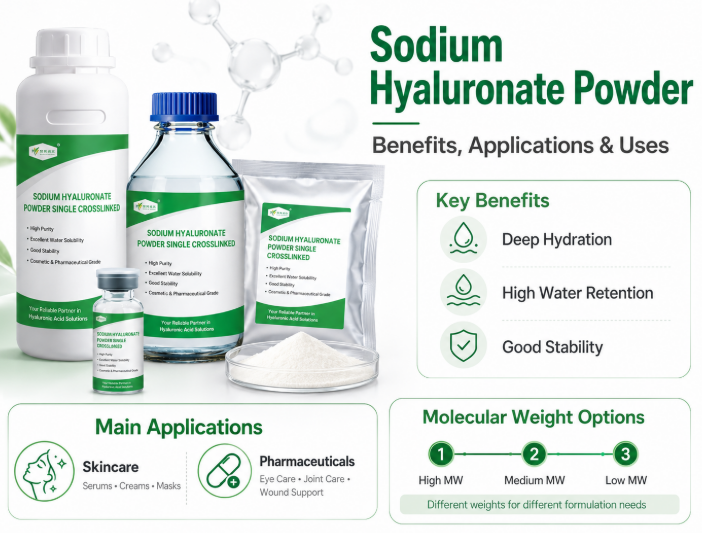
What is Sodium Hyaluronate?
Sodium hyaluronate is a naturally occurring glycosaminoglycan, specifically the sodium salt of hyaluronic acid, known for its exceptional ability to retain moisture and support skin integrity by penetrating deeper into the dermal layers due to its smaller molecular structure.
At its core, this compound acts as a potent humectant, capable of holding up to 1,000 times its weight in water. This remarkable capacity makes it an essential component for maintaining cellular hydration and structural elasticity. In industrial manufacturing, high-purity Sodium Hyaluronate Powder is produced through sophisticated fermentation processes, ensuring that the final material is free from animal-derived impurities and suitable for high-end applications.
The chemical structure of sodium hyaluronate is specifically engineered to provide stability in various pH environments, which is a major advantage for formulators. Unlike unstable raw materials that can break down during the mixing process, this compound maintains its efficacy across a wide spectrum of cosmetic and pharmaceutical formulations. This stability is the primary reason why it is widely preferred for stable, long-lasting products that require consistent performance over time.
Furthermore, the biocompatibility of this substance is unmatched. Because it is chemically similar to the components found naturally within the human extracellular matrix, it is highly tolerated by most individuals. This reduces the risk of irritation, making it a "gold standard" ingredient in sensitive skincare lines. By integrating refined Sodium Hyaluronate Powder, manufacturers can create products that not only hydrate the skin surface but also promote internal repair processes, leading to healthier skin architecture.
Sodium Hyaluronate vs. Hyaluronic Acid
While often used interchangeably in marketing, sodium hyaluronate and hyaluronic acid differ significantly in their chemical form, with sodium hyaluronate being the salt form that offers better stability, improved penetration, and easier formulation in various cosmetic products.
The primary difference lies in their molecular size and solubility. Hyaluronic acid is the raw, pure acid molecule which is relatively large and less stable. Sodium hyaluronate, by contrast, has been converted into a salt form to reduce its molecular weight. This reduction is critical for topical applications, as smaller molecules have a much higher likelihood of penetrating the stratum corneum—the outermost layer of the skin—rather than merely sitting on the surface.
When considering formulation logistics, sodium hyaluronate provides several technical advantages over traditional acid forms:
Solubility: It dissolves more readily in aqueous solutions, allowing for clearer, more consistent gel textures in luxury serums.
Stability: It is less susceptible to oxidation and environmental degradation, leading to a longer shelf life for finished products.
Bioavailability: Its smaller structure allows for better delivery of active ingredients to target cells within the skin, increasing overall treatment efficacy.
From a manufacturing perspective, selecting the right form of hyaluronic derivative determines the end-user experience. Products utilizing high-quality industrial-grade Sodium Hyaluronate Powder often boast superior sensory profiles, meaning they feel less sticky, absorb more quickly, and provide an immediate plumping effect. By understanding these nuances, developers can move away from generic formulas and create highly specialized solutions that address specific skin concerns, such as dehydration, fine lines, or compromised barriers.
Applications of Sodium Hyaluronate
Sodium hyaluronate is utilized across diverse industries, ranging from advanced skincare serums and anti-aging creams to critical medical interventions like ophthalmic surgery, joint injections for arthritis, and wound healing dressings.
In the cosmetics sector, the application of this compound is driven by its ability to restore hydration. As the body ages, natural levels of hyaluronic acid decrease, leading to the appearance of fine lines and a loss of skin firmness. By applying topical products enriched with this ingredient, manufacturers help consumers replenish these levels, resulting in smoother, more supple skin. Common applications include:
Anti-Aging Serums: Targeted formulas that reduce the appearance of wrinkles by providing deep dermal hydration.
Hydration Boosters: Daily use creams that reinforce the moisture barrier to prevent transepidermal water loss.
Post-Procedural Recovery: Soothing gels used after chemical peels or laser treatments to accelerate skin healing and reduce inflammation.
Beyond beauty, the pharmaceutical industry relies on this substance for its viscoelastic properties. In ophthalmology, for instance, it is used in surgical procedures and dry-eye drops to lubricate and protect ocular tissues. In rheumatology, intra-articular injections of high-purity hyaluronate are used to provide cushioning to arthritic joints, effectively reducing pain and improving mobility for patients. These applications demonstrate that the ingredient is not just a trend for skincare, but a vital medical necessity.
Different Molecular Weights of Sodium Hyaluronate
The efficacy of sodium hyaluronate is highly dependent on its molecular weight, where high molecular weight variants provide surface hydration and barrier protection, while low molecular weight variants penetrate deeper to stimulate cellular activity.
Manufacturers must distinguish between these weights to achieve specific performance goals in their products. There is no "one size fits all" approach; rather, the most sophisticated brands use a multi-weight strategy to ensure comprehensive results. The behavior of the molecule changes dramatically based on its mass, measured in Daltons:
High Molecular Weight (>1,000 kDa): These large molecules stay on the skin surface. They are excellent for creating a protective film that prevents water loss and provides an immediate smoothing effect.
Medium Molecular Weight (500 kDa - 1,000 kDa): These offer a balance, providing hydration in the middle layers of the epidermis while also offering soothing benefits.
Low Molecular Weight (<500 kDa): These are the workhorses for anti-aging. They are small enough to reach the deeper layers, where they can help stimulate the skin's own repair processes and improve elasticity.
By blending these different weights, formulators can mimic the skin's natural moisture profile. This strategic combination is what elevates a product from a simple moisturizer to a transformative clinical-grade treatment. Proper utilization of these weights requires a deep understanding of raw material sourcing and consistency in the supply chain to ensure that the active ingredients behave as intended during the application process.
Conclusion
Sodium hyaluronate remains an indispensable asset in the global cosmetics and pharmaceutical markets. Its unique ability to hydrate, lubricate, and support cellular health makes it a versatile ingredient that addresses some of the most common dermatological and medical challenges. By leveraging its stability, biocompatibility, and adjustable molecular weights, manufacturers can develop products that deliver real, measurable results to consumers.
As the industry continues to prioritize transparency and quality, sourcing high-performance raw materials becomes the defining factor for success. Investing in reliable and pure ingredients ensures that the final formulation meets the rigorous standards of modern health and beauty sectors. As we look toward the future of skincare, the role of this remarkable compound will undoubtedly continue to expand, driving innovation and improving quality of life across the globe.