Sodium hyaluronate is an exceptionally safe, biocompatible, non-immunogenic biopolymer when manufactured under ultra-pure, sterile conditions, specifically evaluated in high-grade biomedical applications where biopolymer purity directly governs patient outcomes. When synthesized via advanced bacterial fermentation to produce ultra-pure Injection Grade Sodium Hyaluronate Powder, the biopolymer exhibits optimal biological safety characterized by non-detectable endotoxin levels, minimal nucleic acid residues, low protein contamination, and predictable enzymatic degradation inside human tissues.
Table of Contents
Understanding Sodium Hyaluronate
Safety Profile of Sodium Hyaluronate
Precautions and Recommendations
Understanding Sodium Hyaluronate
Sodium hyaluronate is the sodium salt of hyaluronic acid, a naturally occurring linear glycosaminoglycan composed of repeating disaccharide units of D-glucuronic acid and N-acetyl-D-glucosamine, representing a primary structural component of human extracellular matrix.
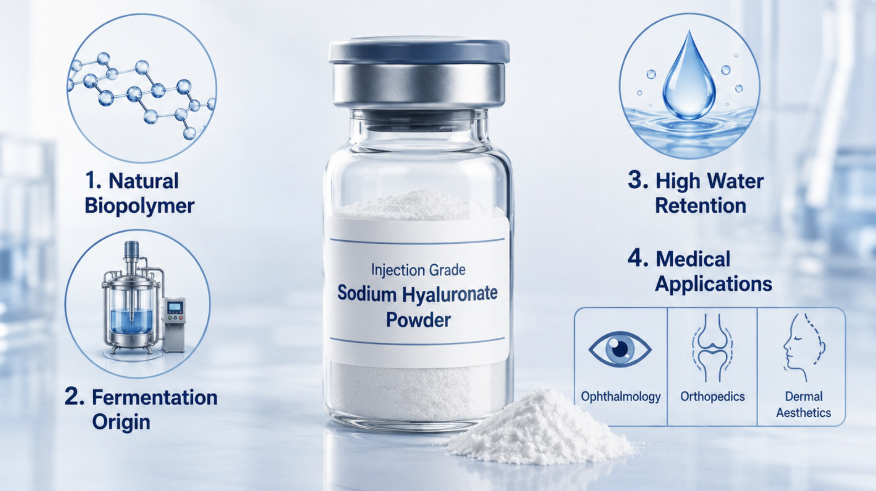
Understanding the fundamental biochemical composition of this biopolymer requires evaluating both its molecular configuration and its industrial synthesis route. Naturally distributed throughout human connective tissues, synovial fluid, skin dermis, and vitreous humor, sodium hyaluronate plays a indispensable role in tissue hydration, viscoelastic lubrication, cellular signaling, and extracellular matrix stabilization. In industrial biomedical production, modern bio-engineering utilizes non-hemolytic Streptococcus zooepidemicus bacterial fermentation to generate pure Injection Grade Sodium Hyaluronate Powder. This microbial process eliminates the cross-species viral contamination risks historically associated with animal-derived extractions such as rooster combs. Microbial fermentation yields biopolymers with highly customizable molecular weights ranging from low molecular weight formulations suitable for rapid cellular absorption to high molecular weight formulations providing superior viscoelastic viscosity.
The biochemical integrity of medical devices and pharmaceutical formulations relies heavily on raw material consistency. High-purity biopolymers generated via fermentation undergo multi-stage purification protocols including membrane filtration, ethanol precipitation, and active carbon clarification. The primary requirement for parenteral applications is absolute batch-to-batch consistency in intrinsic viscosity and molecular mass distribution. When evaluating raw materials for intra-articular injections, dermal fillers, or ophthalmic viscosurgical devices, pharmaceutical formulators specifically demand high-purity Injection Grade Sodium Hyaluronate Powder to guarantee consistent rheological properties, optimal enzymatic stability, and total physiological compatibility.
From a functional standpoint, the biopolymer exhibits unique hydrodynamics. A single gram of hyaluronic polymer can retain up to six liters of water due to its extensive hydrogen-bonding network and negative polyanionic charges at physiological pH. This extraordinary moisture capacity forms viscous physical gels that dampen mechanical stress inside human joints and maintain cellular turgor. The physiological degradation of sodium hyaluronate occurs naturally through endogenous hyaluronidase enzymes, breaking the polysaccharide chain down into harmless monosaccharide constituents that are effortlessly metabolized through standard hepatic clearance pathways without leaving toxic residue behind.
Definition and Origin
Sodium hyaluronate represents a physiological glycosaminoglycan salt ubiquitous across all mammalian species. The biological evolution of manufacturing processes shifted from rooster comb extraction to modern bacterial fermentation using non-pathogenic bacterial strains. Microbial fermentation produces high yields of structural biopolymer while maintaining strict freedom from animal-derived pathogens, prions, and avian proteins. This origin transition dramatically improved chemical purity, standardized polymer chain lengths, and enabled pharmaceutical producers to utilize ultra-pure biopolymers in parenteral dosage forms.
Chemical Properties
Chemically, the biopolymer consists of alternating (1-4)-beta-D-glucuronide and (1-3)-beta-D-acetylglucosamine bonds. It possesses high intrinsic viscosity, pseudoplastic rheological behavior, and high viscoelasticity in aqueous solutions. The molecular weight distribution governs physical performance: high molecular weight variants provide structural cushioning and physical barrier properties, whereas lower molecular weight segments play specific regulatory roles in tissue repair mechanisms. The precise control of heavy metal content, residual protein, microbial load, and bacterial endotoxin levels dictates chemical suitability for injection applications.
Applications of Sodium Hyaluronate
Medical applications for high-purity hyaluronate spans diverse surgical and therapeutic fields:
Ophthalmology: Serves as a viscoelastic agent during cataract surgery to protect corneal endothelial cells.
Orthopedics: Intra-articular injections restore synovial fluid viscoelasticity in osteoarthritic joints, relieving friction and pain.
Medical Aesthetics: Cross-linked dermal formulations utilize the powder to reconstruct facial volume and hydrate dermal tissue.
Surgical Anti-Adhesion: Anti-adhesion barrier gels formulated with high-purity Injection Grade Sodium Hyaluronate Powder prevent postoperative tissue adhesions following abdominal and pelvic surgeries.
| Technical Parameter | Standard Requirement | Injection Grade Specification | Clinical Significance |
| Appearance | White powder or granules | White, odorless powder | Ensures complete physical clarity when dissolved |
| Molecular Weight | 0.5 MDa to 3.0 MDa | 1.0 MDa to 2.5 MDa customizable | Determines solution viscosity and degradation speed |
| Sodium Hyaluronate Assays | Not less than 95.0% | 98.0% to 102.0% purity | Guarantees active constituent concentration |
| Bacterial Endotoxins | Under 0.5 EU/mg | Under 0.05 EU/mg | Prevents pyrogenic reactions during clinical injection |
| Protein Content | Under 0.1% | Under 0.03% | Prevents immunogenic responses and hypersensitivity |
| Intrinsic Viscosity | Defined per grade | 1.5 m3/kg to 3.5 m3/kg | Controls mechanical elasticity inside joints and tissue |
Safety Profile of Sodium Hyaluronate
The safety profile of sodium hyaluronate is thoroughly established through decades of rigorous clinical usage, extensive toxicological studies, and global pharmacopeial standardization, confirming high biological safety across parenteral and surgical interventions.
The safety assessment of biopolymers intended for human injection requires comprehensive toxicological testing, including acute systemic toxicity, subchronic toxicity, genotoxicity, local tolerance, and biocompatibility studies. Because sodium hyaluronate is chemically identical across species, human tissues do not perceive pure hyaluronic acid molecules as foreign antigens. Consequently, toxicological risks do not stem from the polysaccharide chain itself, but rather from impurities present in raw materials. Impurities such as trace residual proteins, nucleic acids, heavy metals, residual solvents, or bacterial endotoxins can trigger biological defense mechanisms. Formulators mitigate these risks by sourcing high-purity Injection Grade Sodium Hyaluronate Powder processed through rigorous purification cycles.
Global regulatory agencies, including the United States Food and Drug Administration (FDA) and the European Medicines Agency (EMA), enforce strict limits regarding endotoxin concentrations in injectable products. Bacterial endotoxins—specifically lipopolysaccharides derived from gram-negative bacterial cell walls—can trigger severe inflammatory responses, fever, and localized tissue necrosis if injected into human vascular or joint systems. Ultra-pure raw materials feature endotoxin levels well below the standard pharmacopeial thresholds (often below 0.05 EU/mg), ensuring that formulated injectable solutions remain non-pyrogenic and safe for delicate human tissues including intra-ocular and intra-articular environments.
In addition to chemical purity, physical biocompatibility is paramount. When injected, high-purity sodium hyaluronate integrates seamlessly into natural matrix networks. Endogenous hyaluronidases gradually degrade the polymer into non-toxic disaccharide units without changing localized tissue pH or eliciting foreign body granuloma formation. European medical device manufacturers continuously prioritize this high biological compatibility, choosing raw material polymers that offer complete batch traceability, rigorous compliance with European Pharmacopoeia (Ph. Eur.) standards, and verified freedom from chemical cross-linking toxicity in linear formulations.
General Safety Considerations
General safety evaluations focus on systemic biocompatibility, pyrogenicity, and metabolic clearance. Linear sodium hyaluronate exhibits zero systemic toxicity even at elevated exposure levels because the body possesses dedicated metabolic pathways for hyaluronic degradation. Long-term safety relies heavily on maintaining sterile manufacturing environments and utilizing non-animal fermentation methods that completely eliminate bovine spongiform encephalopathy (BSE) and transmissible spongiform encephalopathy (TSE) risks.
Potential Side Effects
Side effects associated with hyaluronate medical treatments are overwhelmingly mild, transient, and localized to the injection site. Common minor symptoms include temporary redness, mild swelling, localized discomfort, or minor bruising resulting from needle penetration rather than chemical toxicity. Severe adverse reactions, such as sterile inflammation or granulomatous nodules, occur almost exclusively when improper cross-linking reagents are utilized or when raw materials contain elevated protein and endotoxin impurities.
Allergenic Potential
Pure sodium hyaluronate lacks immunogenic epitopes, rendering genuine allergic reactions exceptionally rare. Historically, hypersensitivity cases were linked to residual avian proteins in older rooster comb extracts. Modern biopolymers produced through advanced bacterial fermentation and ultrafiltration contain minimal protein levels (less than 0.03%), virtually eliminating allergic sensitization. Clinical allergy testing prior to injection is generally unnecessary when using certified medical-grade materials.
Regulatory Status and Clinical Evidence
Sodium hyaluronate holds comprehensive regulatory approvals worldwide as both a pharmaceutical ingredient and a medical device raw material. It is fully standardized across major international pharmacopeias, including the European Pharmacopoeia (Ph. Eur.), United States Pharmacopeia (USP), and Japanese Pharmacopoeia (JP). Decades of peer-reviewed clinical literature substantiate its clinical efficacy and safety in intra-articular joint therapy, ophthalmic surgery, surgical anti-adhesion gels, and esthetic dermal augmentation.
| Safety Criterion | Standard Test Method | Acceptance Threshold | Toxicological Impact |
| Bacterial Endotoxins | LAL Test (Ph. Eur. 2.6.14) | Under 0.05 EU/mg | Eliminates risk of pyrogenic fever and vascular shock |
| Protein Contamination | Bradford Assay / Colorimetric | Under 0.03% | Prevents IgE-mediated allergic sensitization |
| Nucleic Acids (DNA) | UV Absorbance (260 nm) | Under 0.5 A.U. | Prevents unwanted host cell immune activation |
| Heavy Metals | ICP-MS Analysis | Under 10 ppm total | Prevents cellular oxidative stress and cellular toxicity |
| Microbial Limits | Total Aerobic Microbial Count | Sterile / Under 10 CFU/g | Prevents post-injection bacterial infections |
Precautions and Recommendations
Ensuring maximal safety and efficacy when formulating sodium hyaluronate requires strict adherence to material handling protocols, precise molecular weight selection, and rigorous aseptic processing standards.
Pharmaceutical formulators and medical device developers must evaluate several key operational parameters when integrating raw biopolymers into parenteral product designs. First, thermal sensitivity must be carefully managed. High temperatures break glycosidic bonds along the polysaccharide backbone, leading to rapid depolymerization and loss of solution viscosity. Therefore, heat sterilization methods must be carefully optimized, or sterile filtration combined with aseptic filling must be employed to preserve polymer chain length. Sourcing certified Injection Grade Sodium Hyaluronate Powder provides the structural stability and purity needed to maintain mechanical integrity throughout downstream processing.
Second, European clients and global manufacturers focus heavily on customized molecular weight profiles tailored to specific clinical indications. For intra-articular applications, higher molecular weight fractions (ranging between 1.8 MDa and 2.5 MDa) are preferred to replicate natural synovial fluid elasticity and resist rapid enzymatic degradation within the joint cavity. Conversely, for ophthalmic solutions, specific viscosity profiles are selected to ensure rapid coating of corneal tissues while maintaining optical transparency. Understanding these functional demands enables raw material suppliers to design tailored purification and precipitation parameters, ensuring raw material specifications perfectly match technical formulation targets.
Finally, proper raw material storage is essential to prevent degradation prior to formulation. High-purity biopolymer powder must be preserved in sealed, moisture-proof containers shielded from light and maintained under controlled cool temperatures (typically 2 to 8 degrees Celsius). Exposure to humidity or elevated ambient temperatures promotes gradual molecular degradation and increases moisture absorption. By implementing stringent quality control protocols from raw material intake through final product packaging, medical manufacturers guarantee the highest standards of patient safety and clinical reliability.
| Clinical Application | Recommended Molecular Weight | Target Intrinsic Viscosity | Primary Functional Objective |
| Intra-Articular Injection | 1.8 MDa to 2.5 MDa | 2.8 to 3.5 m3/kg | Restores joint lubrication and dampens mechanical impact |
| Ophthalmic Viscoelastic | 1.5 MDa to 2.2 MDa | 2.2 to 3.0 m3/kg | Protects corneal endothelial cells during intraocular surgery |
| Dermal Fillers | 1.0 MDa to 1.8 MDa | 1.8 to 2.6 m3/kg | Provides physical tissue volumization and long-term hydration |
| Anti-Adhesion Gels | 1.2 MDa to 2.0 MDa | 2.0 to 2.8 m3/kg | Forms temporary mechanical physical barrier post-surgery |
Storage and Quality Maintenance Guidelines: Always maintain raw material packaging in original sealed conditions under 2 to 8 degrees Celsius in dark, dry room environments. Avoid repeated freeze-thaw cycles after reconstitution in sterile aqueous media, and ensure that all dissolution equipment utilizes non-reactive stainless steel or glass contact surfaces to prevent metallic ion contamination and catalytic depolymerization.