If you are purchasing or evaluating cosmetic-grade sodium hyaluronate, you should not make a decision based only on the product name or quoted price. A more reliable approach is to first clarify which type of skincare product the raw material will be used for, and then confirm whether its application direction, specification data, basic condition, sample information, and batch records correspond to your actual requirements. Only by considering these details within the same evaluation framework can you compare different raw material options more clearly.
1. What Should You Confirm First Before Purchasing Cosmetic-Grade Sodium Hyaluronate?

Before purchasing, first clarify which type of skincare product the raw material will be used for, what application direction it needs to meet, and what kind of user experience you expect the product to provide. Although toners, serums, lotions, creams, gels, and masks are all skincare products, the key points to consider in their raw material information and application performance are not exactly the same.
Once the product use has been defined, you can further organize the information that needs to be confirmed, such as whether the raw material is intended for cosmetic applications, whether the specification data is complete, whether the sample corresponds to the document description, and whether the available information supports your purchasing decision. This can help you avoid comparing products based only on their names, prices, or individual specifications before the intended use has been clarified.
The desired product experience should also be described clearly before purchasing. Depending on your actual requirements, you can first determine whether you are more concerned with a fresh, hydrated, supple, smooth, or other skin feel, and then check whether the raw material information supports that application direction. Only when the intended use, documentation, and sample performance correspond to one another can the comparison provide a reliable basis.
2. How Should You Read the Product Specification Sheet and Application Information?
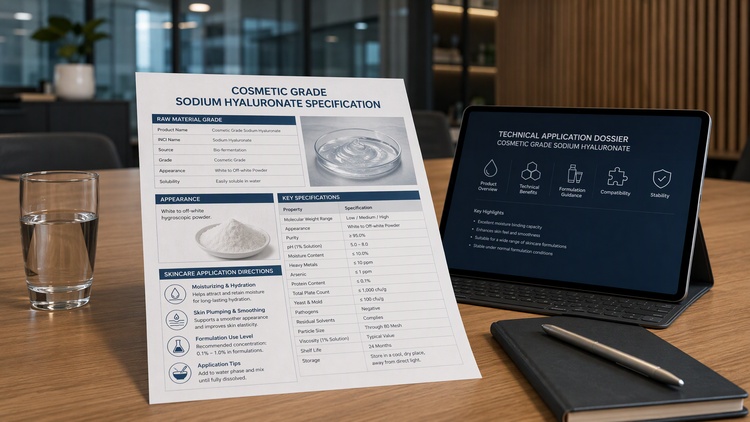
The product specification sheet and application information should be read together. The specification sheet is generally used to confirm the product name, raw material grade, appearance, basic specifications, intended applications, packaging, and batch information. Application information helps you understand how these details relate to skincare uses. The two types of documents serve different purposes, but both should correspond to the product you intend to purchase.
When reviewing the specification sheet, you can first confirm whether the product name and grade are clearly stated, and then check whether the appearance, basic specifications, packaging information, and batch information are complete. For the application information, focus on whether the described product directions and use characteristics meet your current requirements. If you are evaluating sodium hyaluronate for skincare products, the relevant information should clearly indicate its cosmetic application range rather than provide only a name without any explanation of intended use.
A single specification can describe only one aspect of the raw material and cannot fully represent its application value. Comparing the specification sheet, application information, and actual product requirements together can help you distinguish between what information is included in the documents and whether that information is genuinely relevant to your intended use.
3. How Should You Understand the Appearance, Odor, and Dissolution Information for Sodium Hyaluronate?

Appearance, odor, and dissolution information can help you understand the basic condition of sodium hyaluronate. They are also useful points of reference when making an initial comparison of samples before purchasing. The descriptions in the documents should be clear, consistent, and capable of being matched to the sample you receive.
When reviewing appearance, you can check whether the sample form and color correspond to the document description. When considering odor, you can look for any unusual condition that differs from the information provided. When reviewing dissolution information, focus on whether the description helps you understand the raw material’s basic use condition. These details cannot independently determine whether the raw material is suitable for a particular product, but they can serve as references for preliminary screening and sample confirmation.
When comparing different options, it is preferable to use the same documentation criteria. Checking the document description against the sample condition item by item can reduce the risk of misjudgment caused by incomplete or unclear information, and it can also help you raise more specific questions during further confirmation.
4. What Is the Significance of Batch Information, Sample Documents, and Formal Purchasing Documents?

Batch information, sample documents, and formal purchasing documents together establish the correspondence between the raw material and its supporting information. The batch number, production date, and expiry date can help you confirm which batch the sample belongs to. Sample documents are used to understand the basic condition and application information of the current sample, while formal purchasing documents should correspond to the product and batch actually delivered.
If the sample name, specification description, batch number, and document information cannot be matched, subsequent comparisons will lack a clear basis. Therefore, when confirming a sample, you can check these details at the same time and verify whether the sample documents are consistent with the formal documentation. For products that require ongoing purchasing, this correspondence is particularly important because the records for different batches should remain clear, continuous, and traceable.
Complete batch information does not mean that a particular raw material is necessarily more suitable for your product. However, it can help you confirm the purchasing object and the scope of the supporting documents more accurately. The clearer the information, the fewer uncertainties will remain during future comparisons and ongoing purchasing.
5. How Can You Compare the Completeness of Information for Different Sodium Hyaluronate Products?
When comparing different sodium hyaluronate products, you can follow the sequence of “application direction — specification information — basic condition — batch information — sample correspondence.” This sequence allows you to confirm the intended use first and then check whether the documents and sample support one another, rather than allowing price or a single specification to influence the decision from the beginning.
First, you can confirm whether each product is suitable for the current skincare application. Next, compare the product name, grade, appearance, basic specifications, and packaging information. Then review whether the appearance, odor, and dissolution information is clearly described. Finally, check whether the batch information, sample documents, and formal purchasing documents correspond to one another.
Clear, consistent, and verifiable information does not mean that one product is suitable for every application, but it can provide a fairer basis for comparison. By contrast, if an option provides only a brief product name or promotional description while lacking information relevant to your purchasing requirements, its suitability should not be judged solely by price or surface-level information.
6. Which Missing Information Requires Further Confirmation, and How Can You Establish Selection Criteria?
If the documents do not clearly state the cosmetic application direction, raw material grade, basic appearance, dissolution information, batch correspondence, or storage information, you can request further confirmation before purchasing. These details relate respectively to the intended use, product identity, basic condition, sample understanding, document consistency, and subsequent storage. If important information is missing, the basis for selection may not be complete.
When establishing selection criteria, you can first list the product type, expected user experience, required raw material grade, and documents that must be confirmed, and then compare different samples using the same criteria. For example, first clarify which type of skincare product the raw material will be used for, then confirm which documents must be obtained before purchasing, and finally compare the specifications, application information, basic condition, and batch information of different samples.
The final selection should match your product use, documentation requirements, and ongoing purchasing needs. A consistent comparison standard can reduce the uncertainty of selecting a raw material based only on its name, promotional description, or price, and can also make it easier to determine which information is sufficient and which details still require confirmation.
Conclusion
Before purchasing cosmetic-grade sodium hyaluronate, you can first clarify the product use, then confirm the application direction, specification information, basic condition, sample information, and batch records, and establish selection criteria that match your own product requirements.
Further Reading
If you would like to learn more about the application directions associated with different hyaluronic acid grades, read What Are The Different Grades of Hyaluronic Acid to further distinguish cosmetic, food, pharmaceutical, and other grades.
If you would like to understand the basic properties and water-retention performance of sodium hyaluronate powder, read What are the benefits of sodium hyaluronate powder as supplementary information about sodium hyaluronate raw materials.