If you are sourcing or evaluating sodium hyaluronate for skincare products, molecular weight is usually one of the key specifications to understand. It affects not only the viscosity of the raw material solution, but also transparency, flowability, spreadability, lubricity, film-forming feel, and residue after use. However, molecular weight cannot be assessed separately from the dosage, formulation environment, product format, and processing conditions. When comparing different samples, you need to review the test data and confirm whether the data match the intended product application.
1. Why Does the Molecular Weight of Sodium Hyaluronate Affect the Skin Feel of Skincare Products?
The molecular weight of sodium hyaluronate affects its resistance to flow and film-forming behavior in the aqueous phase, and may therefore change the smoothness and spreading speed of a skincare product during application, as well as the film feel after use. In general, higher-molecular-weight materials are more likely to provide a noticeable lubricating and cushioning feel, while lower-molecular-weight materials generally maintain better flowability. This does not mean, however, that a higher molecular weight will always feel sticky or that a lower molecular weight will always feel refreshing.
Molecular weight can help you make an initial assessment of the likely behavior of the raw material in the aqueous phase. When the molecular chains are longer, the material may form a more pronounced aqueous structure at the same concentration and under the same test conditions, and the solution may offer greater resistance to flow. When the molecular chains are shorter, the solution will generally flow more easily and may create less drag during application. These differences can further affect the spreading speed of the product, the lubricity on the skin, and the film-forming feel after drying.
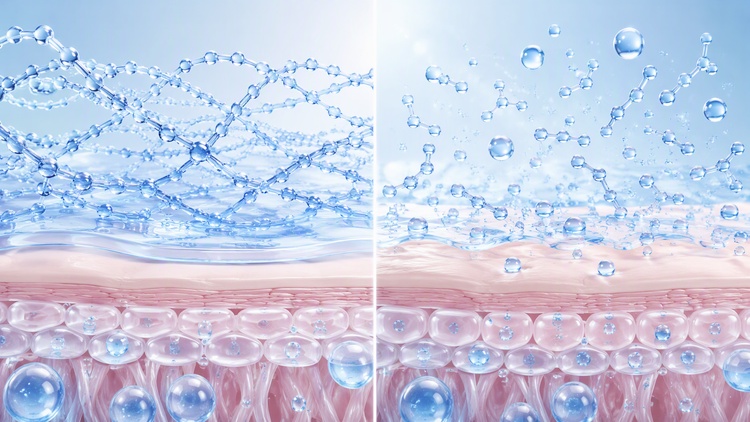
If you value a more noticeable lubricating and moisturizing cushioning feel, you can focus on comparing the performance of higher-molecular-weight samples at the intended use level. If you are more concerned with a watery texture, rapid spreading, and a lightweight feel, you can pay closer attention to the flowability of lower-molecular-weight samples. Molecular weight alone is still not enough to make the final selection, because samples within the same molecular-weight range may produce different skin feels when their purity, test conditions, dosage, or formulation environment differ.
You also need to distinguish between the immediate skin feel and the residue that remains after some time. Some materials feel smooth immediately after application but leave a noticeable film as water decreases. Other samples may feel slightly sticky at first but become more comfortable after spreading. Therefore, when comparing samples, you should consider the feel upon initial contact, the slip during application, and the film feel and residue after a period of time. A raw material should not be judged only by how it feels at one particular moment.
2. Does a Higher Molecular Weight Always Make a Skincare Product More Sticky?
Not necessarily. A higher molecular weight may increase the viscosity and film-forming tendency of the aqueous phase, but whether the finished product feels sticky also depends on the dosage of sodium hyaluronate, other thickening ingredients, humectants, the oil-phase ratio, and the overall formulation structure. When comparing raw materials, you should not look only at labels such as “high molecular weight” or “low molecular weight.” You should also confirm the concentration, temperature, and test method used to obtain the result.
The dosage directly affects the contribution of the raw material to the final texture. The same high-molecular-weight sodium hyaluronate may provide only a mild lubricating feel at a lower use level, while a higher use level may produce more noticeable aqueous-phase resistance, stringiness, or residue. Therefore, when requesting samples or data from a raw material source, you should also understand the recommended use range and the corresponding test conditions. This helps prevent the performance observed at one relatively high use level from being treated as a fixed characteristic of the material in every product.
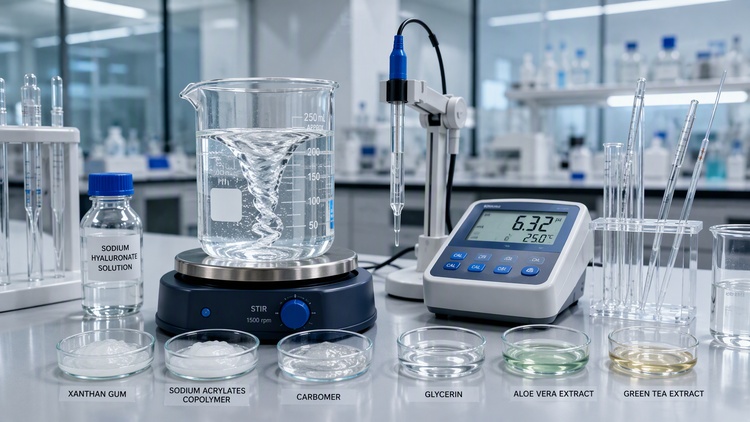
Other ingredients can also change how you assess a sodium hyaluronate sample. Ingredients such as carbomer, cellulose-based thickeners, and xanthan gum may increase system viscosity. Humectants such as glycerin, butylene glycol, and propylene glycol may intensify the moisturized or sticky feel. The oil-phase ratio in emulsions and creams can affect spreading resistance and heaviness. Therefore, even when the sodium hyaluronate dosage remains unchanged, the overall texture of the finished product may differ because the other ingredients have changed.
A higher viscosity does not necessarily mean a heavier user experience. Some high-viscosity systems can still spread well and feel smooth, while some low-viscosity systems may leave a noticeable sticky feel because they contain relatively high levels of polyols or film-forming ingredients. For you, the more important question is whether the raw material can meet the target product’s overall requirements for moisturized feel, lubricity, and freshness, rather than simply looking for the sample with the lowest or highest viscosity.
3. Is Lower-Molecular-Weight Sodium Hyaluronate Always More Suitable for Lightweight Skincare Products?
Not necessarily. Lower-molecular-weight sodium hyaluronate generally helps maintain good flowability, but “lower molecular weight” cannot be directly equated with “more refreshing.” If you are selecting a raw material for a mist, toner, or lightweight serum, you should compare not only molecular weight, but also the sample’s transparency, flowability, lubricity, and stability after storage at the intended use concentration.
Lower-molecular-weight materials may be more suitable for aqueous products that need to flow quickly and spread easily. For a mist, you need to consider whether the liquid remains uniform and is suitable for output through the spray head. For a toner, you need to consider flowability during pouring and application, as well as the refreshing feel. For a lightweight serum, you should not pursue low viscosity alone; you also need to confirm that the product retains sufficient lubricity and moisturized feel.
A more refreshing feel is not determined by the molecular weight of sodium hyaluronate alone. The proportions of water, oil, solvents, other humectants, thickeners, and film-forming ingredients in the formulation will all affect the final sensory profile. A lower-molecular-weight sample may feel light in a simple aqueous solution but may still feel sticky or leave a film after being used in a finished product containing higher levels of humectants or film-forming ingredients. Therefore, when selecting samples, you should obtain information about their performance under the actual application conditions instead of making a decision based only on molecular weight.
If a raw material is described as suitable for lightweight skincare products, you should also pay attention to its condition after storage. A sample that is clear and flows smoothly immediately after preparation may not remain stable over time. Transparency, viscosity, water separation, sedimentation, and residue can all change with storage conditions. Combining this information with sample documentation, test data, and application records will help you assess more accurately whether lower-molecular-weight sodium hyaluronate meets your product requirements.
4. How Should the Molecular Weight of Sodium Hyaluronate Be Selected for Different Skincare Formats?
Different product formats have different requirements for sodium hyaluronate. When selecting a raw material, you should first clarify the texture and sensory experience expected from the finished product, and then compare the suitability of samples with different molecular weights. The same molecular-weight grade should not be applied directly to every skincare product.
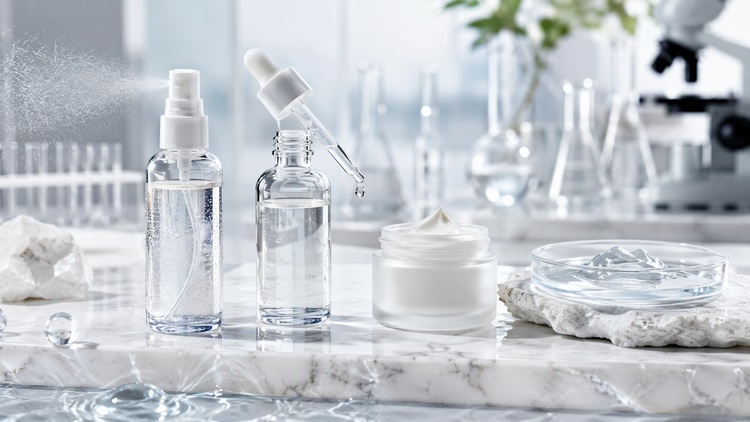
Toners and mists generally require good flowability, transparency, spray performance, and a refreshing feel. If the aqueous phase is too viscous, it may affect pouring, pumping, or spray-head atomization. If it lacks lubricity and moisturized feel, however, the finished product may feel too thin. You can focus on understanding the sample’s hydration state, transparency, flowability, and spray performance at the intended concentration.
Serums need to balance spreadability, lubricity, moisturized feel, and residue. A serum is not necessarily better just because it is more viscous. Relying on high viscosity alone to create a rich appearance may lead to stringiness, stickiness, or pilling when layered with other products. When selecting a sample, you should consider its spreading speed, smoothness, film-forming feel, and performance when used together with other moisturizing ingredients in the serum system.
Lotions and creams require attention not only to spreadability and heaviness, but also to emulsion stability. Sodium hyaluronate contributes to the aqueous-phase structure, while the oil phase, emulsifiers, and thickeners affect the overall sensory profile. You can focus on whether the sample remains uniform in the lotion or cream system, whether it spreads easily during application, whether it creates excessive heaviness or pilling, and whether the appearance and texture remain stable after storage.
Gels and sheet-mask essences require attention to film-forming feel, residence time, extensibility, and storage stability. A gel should maintain a uniform structure and suitable extensibility. A sheet-mask essence should spread easily during use while avoiding excessive stringiness or uncomfortable tightness after drying. For these products, you should also understand whether the sample shows water separation, sedimentation, structural changes, or a significant decrease in viscosity after storage.
5. Why Does the Same Sodium Hyaluronate Perform Differently in Different Skincare Formulations?
When the same sodium hyaluronate is used in different products, it is exposed to different pH values, salt and electrolyte environments, and ingredient combinations. As a result, transparency, viscosity, flowability, and stability may also differ. The raw material test results you see generally represent its condition under specified test conditions and cannot directly replace an assessment of its performance in a specific finished product.
pH affects transparency, viscosity, and system stability. A sample with a particular molecular weight may remain stable in a simple aqueous phase close to neutral, but its viscosity or appearance may change in a system with a more pronounced acidic or alkaline environment. Therefore, when requesting application information, you should confirm whether the test environment is close to your product conditions and pay attention to the sample’s performance within the relevant pH range.
Salt and electrolyte environments can also affect the state of the sodium hyaluronate chains in the aqueous phase. Products containing salts, minerals, or multiple ionic ingredients may show changes in viscosity, transparency, and flowability. Botanical extracts, proteins, and active ingredients may also cause turbidity, sedimentation, a decrease in viscosity, or other compatibility issues. For you, this information can help determine whether a sample with a particular molecular weight is worth taking forward for application evaluation.
Thickeners, film-forming agents, and other humectants can also create additive effects. When several ingredients simultaneously strengthen the system structure or surface film, the finished product may show stringiness, stickiness, increased application resistance, or pilling. Certain oil-phase and emollient ingredients, in contrast, may improve spreading and make the same raw material feel smoother. Therefore, you cannot determine the final performance of sodium hyaluronate in a finished product solely from the condition of its raw material solution.
The order of addition, hydration time, mixing method, and processing temperature are important process information that can affect the finished product. When evaluating a sample, you can treat these points as information to clarify with the raw material source and confirm the recommended dispersion, hydration, and storage conditions. This can reduce sample differences caused by inconsistent handling and help you determine whether the raw material is suitable for your existing product conditions.
6. How Can You Determine Whether a Particular Molecular Weight Is Suitable for a Skincare Formulation Through Small-Scale Testing?
If you need to choose among samples with different molecular weights, the most useful reference is not the raw material name alone, but the actual performance of the samples under comparable conditions. During comparison, the dosage, temperature, test method, and observation period should be kept as consistent as possible. You should also consider the raw material state, finished-product appearance, texture, and changes during storage.
First, compare the dispersion, hydration, and dissolution behavior of samples with different molecular weights. You can observe whether the sample wets easily after entering the aqueous phase, whether it forms agglomerates, how long it takes to become uniform, and whether there are clear differences among the samples. This information can help you determine whether the raw material is compatible with the use conditions and processing requirements of your existing product.
Next, compare transparency, viscosity, flowability, and spreadability. Transparency can indicate whether turbidity or obvious compatibility changes have occurred. Viscosity can help you understand the structure of the aqueous phase. Flowability and spreadability are closer to the texture of the finished product. To make the comparison more reliable, record the concentration, temperature, instrument, and test method, and avoid directly comparing figures obtained under different conditions.
The sensory evaluation should also be specific. You can separately observe the slip immediately after application, whether stringiness occurs during repeated spreading, whether pilling appears when layered with other skincare products, and whether an excessively heavy film or sticky feel remains as the water decreases. Such records are more helpful for making a clear comparison among different samples than simply describing them as “refreshing” or “viscous.”
At the same time, pay attention to stability characteristics such as phase separation, water separation, and sedimentation. For lotions, gels, and sheet-mask essences, you should also observe changes in appearance, structure, and flow behavior. If conditions permit, you can request application information based on heating, cooling, filling, or storage observations to help assess the sample’s stability throughout the actual product cycle.
Finally, compare the sensory feel immediately after preparation with the feel after storage. Some samples may perform well initially but develop increased stickiness, a stronger film feel, water separation, or structural changes over time. Comparing the immediate condition with the stored condition can help you determine whether a particular molecular weight is suitable for long-term use rather than only for short-term sample presentation.
7. How Should Molecular Weight and Viscosity Data for Sodium Hyaluronate Be Compared?
Molecular weight and viscosity are related but distinct indicators. Molecular weight reflects the size range of the molecular chains in the raw material, while viscosity reflects the resistance to flow of a solution at a specific concentration, temperature, and set of test conditions. When comparing different samples, you should first confirm that the test conditions are consistent, and then interpret the data together with the target product format and application performance.
The same raw material may show different viscosity values at different concentrations. Temperature changes can also alter flow behavior. Test results may likewise differ when pure water, a buffer system, or a salt-containing system is used. Therefore, when reviewing molecular-weight or viscosity data, you should also confirm the test concentration, temperature, solvent, unit, instrument conditions, and test method. If these conditions differ, comparing the figures alone may lead to an incorrect conclusion.

It is also not advisable to judge the quality of a raw material based on a single figure. A higher-viscosity sample is not necessarily suitable for every serum, and a lower-molecular-weight sample is not necessarily suitable for every mist or toner. A more useful approach is to confirm whether the sample meets your requirements for product format, intended dosage, appearance, sensory feel, storage conditions, and cost range.
Runxin’s related article explains the differences in applications among pharmaceutical-grade, cosmetic-grade, food-grade, ophthalmic-grade, and veterinary-grade hyaluronic acid. It also notes that cosmetic-grade hyaluronic acid can be used in different surface-moisturizing and skincare formulations according to molecular weight. You can first confirm whether the application range of a particular grade matches your skincare use, and then compare the molecular weight, viscosity, and sample performance. For more information, see What Are The Different Grades of Hyaluronic Acid?
Test data and application samples serve different purposes. Test data help you understand the specification range and batch status of the raw material, while application samples help you assess its appearance, texture, and sensory performance in a specific product. Considering both types of information together allows you to evaluate more comprehensively whether sodium hyaluronate is suitable for your product requirements.
8. Can Sodium Hyaluronate with Multiple Molecular Weights Be Used Together in the Same Skincare Product?
Yes, but whether blending multiple molecular weights is worthwhile depends on your specific requirements for the finished product’s flowability, lubricity, film-forming feel, and moisturized feel. Using multiple molecular weights is not automatically better, and the blending ratio cannot be assessed separately from the product format, dosage, and other formulation ingredients.
A single-molecular-weight sample may have certain application limitations. A higher-molecular-weight sample can provide a more noticeable film feel and aqueous-phase structure, but may increase stickiness or spreading resistance in a lightweight system. A lower-molecular-weight sample may support flowability and freshness, but may not provide enough lubricity or film-forming performance when used alone in a product that requires these characteristics. The purpose of blending is to find a combination that better matches the required product performance.
After different molecular weights are blended, viscosity, slip, and film-forming feel may change. The higher-molecular-weight portion may strengthen the continuous film and cushioning lubricity, while the lower-molecular-weight portion may help the system retain a degree of flowability. However, blending may also result in stickiness, stringiness, increased spreading resistance, or heavier residue. The result therefore cannot be inferred from the performance of an individual sample alone.
When evaluating a blending plan, you should focus on changes in transparency, flowability, and residue at different ratios. Some samples may remain clear when used individually but show reduced transparency or increased viscosity after blending. Other samples may feel smooth immediately after preparation but develop a more noticeable film after storage. Blended samples should therefore be supported by comparative information at different ratios rather than by only one fixed combination.
If the product also contains other humectants and thickeners, the blending effect may change further. When the formulation already has strong thickening or film-forming characteristics, adding a higher-molecular-weight portion may increase the risk of pilling and residue. A high humectant ratio may also intensify the moisturized or sticky feel. You should focus on the appearance, transparency, phase separation, water separation, sedimentation, viscosity, flowability, and sensory feel after storage of the blended samples.
9. What Are the Most Common Mistakes When Selecting the Molecular Weight of Sodium Hyaluronate?
The most common mistake is treating one figure, such as molecular weight or viscosity, as the final conclusion. For you, a meaningful selection should consider the test conditions, target product format, intended dosage, formulation environment, sample performance, and storage stability together.
First, looking only at molecular weight without considering the test conditions. Different concentrations, temperatures, solvents, units, and methods can affect the data. Comparing molecular weight or viscosity without the test conditions may therefore lead to an inaccurate conclusion. Second, looking only at viscosity without observing the actual texture. A viscosity figure only describes the resistance to flow in a particular test system; it cannot fully show whether the finished product will feel smooth during application, become stringy, or feel sticky after storage.
Third, assuming that a higher molecular weight always provides better moisturizing performance. A higher molecular weight may be more likely to form a surface film, but the final moisturized feel is also related to the dosage, formulation base, and other humectants. Fourth, assuming that lower molecular weight is suitable for every lightweight product. Lower molecular weight may support flowability, but transparency, spray performance, film-forming feel, residue, and storage stability still need to be considered.
Fifth, equating lower molecular weight directly with easier absorption. Molecular weight is one property of the raw material and cannot replace an assessment of the finished product’s performance. Sixth, overlooking the effects of the actual dosage and other formulation ingredients. The same sodium hyaluronate may show different viscosity and skin feel at different dosages and in different thickening, moisturizing, and oil-phase systems.
Seventh, looking only at the raw material solution rather than the actual application sample. A raw material solution can help you make a basic comparison, but it cannot fully represent the final state in a serum, lotion, cream, gel, or sheet-mask essence. Eighth, looking only at the freshly prepared state and not at changes during storage. Phase separation, water separation, sedimentation, viscosity changes, and changes in sensory feel may occur during storage. This information should therefore be included in your sample evaluation and raw material selection.
10. How Can You Determine Whether a Particular Molecular Weight of Sodium Hyaluronate Is Truly Suitable for Skincare Products?
Determining whether a particular molecular weight is suitable for a skincare product requires more than one test figure or a single observation of the raw material solution. You need to make a comprehensive comparison based on the target sensory feel, ingredient compatibility, appearance, processing suitability, storage stability, batch consistency, and conditions for continued use.
First, confirm whether it matches the sensory requirements of your target product. Toners and mists generally place greater emphasis on flowability and freshness. Serums need to balance lubricity and residue. Lotions and creams need to balance spreadability and heaviness. Gels and sheet-mask essences require attention to film formation, extensibility, and residence. There is no single best molecular weight for every product format. The suitable sample should correspond to the user experience defined for your product.
Next, confirm whether it is compatible with the other ingredients in the product and whether it maintains suitable transparency and viscosity. You can focus on the sample’s performance in the presence of the target pH, salts, electrolytes, botanical extracts, proteins, active ingredients, thickeners, film-forming agents, and other humectants. If obvious turbidity, sedimentation, abnormal viscosity, or changes in flow behavior appear, you should assess its suitability with caution.
You should also confirm whether the raw material can withstand the heating, emulsification, filling, or gel-forming conditions involved in the product. For you, the key point is not to master the specific production operation, but to confirm whether the raw material documentation describes the relevant use conditions and whether the sample retains a uniform appearance and stable texture after the relevant steps. The more complete the documentation, the clearer your assessment of potential application risks will be.
Phase separation, water separation, sedimentation, or viscosity changes after storage are also important evaluation criteria. You can compare the freshly prepared sample with the stored sample and observe whether the appearance, flowability, texture, and sensory feel remain similar. If the sample remains stable after storage, this indicates a more reliable level of compatibility between that molecular weight and the product system.
Whether different batches can maintain similar product performance also affects the stability of your future purchasing. In addition to confirming the molecular-weight range and viscosity data, you should review batch test documentation, sample comparisons, and storage records. Finally, you should consider whether the raw material meets your product conditions, purchasing plan, and cost requirements. A molecular weight is more suitable for long-term selection only when user experience, application stability, batch consistency, and purchasing conditions are balanced.
Runxin’s related article introduces the water-retention properties of sodium hyaluronate powder, its role in maintaining skin moisture and supporting elasticity, and the convenience of incorporating the powder form into different formulations. You can use this information to further understand the basic application characteristics of sodium hyaluronate powder and then compare different samples according to your specific product requirements. For more information, see What are the benefits of sodium hyaluronate powder?
Further Reading
What Are The Different Grades of Hyaluronic Acid?: Learn about the application scenarios of different hyaluronic acid grades and the differences in skincare applications of cosmetic-grade hyaluronic acid with different molecular weights.
What are the benefits of sodium hyaluronate powder?: Learn about the basic properties of sodium hyaluronate powder, its water-retention performance, and its application background in skincare formulations.