To rigorously evaluate the quality of Injection Grade Sodium Hyaluronate Powder, analytical procedures must encompass comprehensive physicochemical characterization, high-performance molecular weight determination, precise pH verification, strict purity and impurity profiling, stringent microbial limit control, and high-accuracy content assays performed in compliance with international pharmacopeial standards such as EP and USP.
At a Glance
| Section | Summary |
| 1. Visual Inspection | Evaluates the physical appearance, powder color, particulate clarity, and visual solution quality of Injection Grade Sodium Hyaluronate Powder under controlled light. |
| 2. Loss on Drying Test | Determines volatile residual content and moisture retention in Injection Grade Sodium Hyaluronate Powder using precise thermogravimetric techniques. |
| 3. Molecular Weight & Intrinsic Viscosity Testing | Measures polymer chain length, intrinsic viscosity, and molecular weight distribution of Injection Grade Sodium Hyaluronate Powder via SEC-MALLS and capillary viscometry. |
| 4. pH Testing | Verifies the ionic equilibrium, physiological neutrality, and buffer stability of reconstituted Injection Grade Sodium Hyaluronate Powder solutions using potentiometric electrodes. |
| 5. Impurity Testing | Quantifies nucleic acids, proteins, heavy metals, residual solvents, and endotoxins in Injection Grade Sodium Hyaluronate Powder using UV-Vis and LAL assays. |
| 6. Microbial Limit Control | Ensures sterility, total viable aerobic count control, and complete absence of objectionable pathogens in biological grade polymer lots. |
| 7. Content Assay | Measures exact sodium hyaluronate chemical purity and glucuronic acid concentration through HPLC-SEC or carbazole colorimetric methods. |
1. Visual Inspection
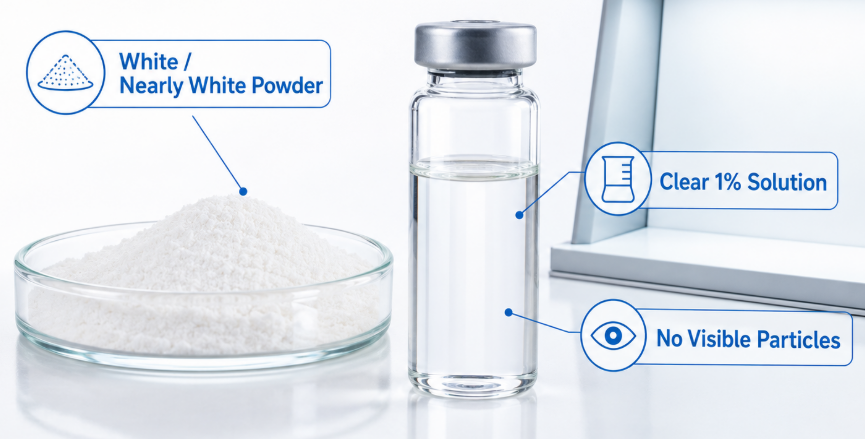
Visual inspection establishes the initial baseline physical quality, color consistency, and macro-particle contamination parameters of bulk Injection Grade Sodium Hyaluronate Powder.
The visual inspection of raw polymer material represents a critical preliminary gate in raw material release protocols within regulated pharmaceutical manufacturing environments. When evaluating high purity injection grade sodium hyaluronate powder, analysts examine the unconstituted dry matrix for uniform whiteness, fibrous or granular powder topography, and total absence of extraneous foreign debris or discolored specs. Because bioprocessing cross-linking or fermentation anomalies can induce thermal degradation or oxidative charring, visual uniformity serves as a direct indicator of downstream solution clarity and molecular integrity.
Beyond bulk powder appraisal, complete visual assessment requires dissolving a precise quantity of Injection Grade Sodium Hyaluronate Powder in sterile pyrogen-free water to achieve a standardized 1.0 percent concentration. The reconstituted solution is inspected against light and dark backdrops under calibrated illumination ranging between 2000 and 3750 lux. Technicians scrutinize the liquid matrix for haziness, opalescence, insoluble fibers, micro-bubbles, or tinting. An optimal biopharmaceutical batch yields a completely clear, colorless, transparent viscous fluid free from airborne lint or metallic micro-particles.
Furthermore, visual metrics directly influence product solubility speed and customer acceptance during large-scale manufacturing operations. Industry quality control protocols require visual assessments to be conducted under strict laminar flow hoods to prevent ambient particulate contamination during sample handling. This initial physical assessment serves as an immediate, cost-effective filter before advancing samples to expensive instrument-based testing workflows.
| Visual Inspection Parameter | Standard Requirement Specification | Testing Condition / Equipment |
| Powder Appearance | White or almost white powder/fibrous aggregate | Ambient light, clean glass Petri dish |
| Solution Appearance (1% w/v) | Clear, colorless, completely transparent liquid | Calibrated Black/White viewing station (2000-3750 lux) |
| Clarity & Degree of Opalescence | Less than Reference Suspension I | Cuvette comparison, ISO 7027 nephelometry |
| Foreign Particulate Matter | Absence of visible fibers or discrete particles | Automated or manual visual inspection booth |
1. Key Factors Influencing Physical Clarity
The physical clarity of reconstituted solutions is primarily influenced by the purity of the raw water supply and the efficiency of membrane filtration during production. Residual insoluble cellular debris from bacterial fermentation can introduce persistent opalescence in reconstituted hydrogels.
2. Standardized Viewing Conditions
Testing environments must strictly control ambient luminescence to prevent false-positive particulate detection. Specialized inspection cabinets equipped with dual-light sources ensure standardized visual evaluations across different analytical facilities.
3. Sample Preparation Protocol
Sample reconstitution must occur under gentle magnetic agitation to prevent mechanical shear degradation of the high molecular weight polymer chains, ensuring that true optical clarity is accurately measured.
Optical Clarity Verification Tip: Reconstituted samples should undergo degasification via mild vacuum exposure prior to visual inspection to eliminate micro-entrained air bubbles that could be misidentified as particulate contaminants.
2. Loss on Drying Test
The loss on drying test quantitatively measures volatile organic components and residual moisture present within the dry matrix of Injection Grade Sodium Hyaluronate Powder.
Sodium hyaluronate is a highly hydrophilic glycosaminoglycan containing numerous hydroxyl and carboxyl functional groups that readily adsorb atmospheric moisture. Accurate quantification of moisture content through Loss on Drying is vital because excess residual water directly accelerates hydrolytic chain cleavage over time, causing premature molecular weight degradation during storage. Maintaining controlled, low moisture levels ensures long-term physicochemical stability for formulated finished products.
The testing protocol requires placing an accurately weighed aliquot of Injection Grade Sodium Hyaluronate Powder into a pre-dried, constant-weight weighing bottle. The sample is transferred to a vacuum drying oven maintained at a precise temperature, typically 105 degrees Celsius, under reduced pressure for a duration of 6 hours, or dried over phosphorus pentoxide under specified high-vacuum conditions. The weight difference prior to and following thermal exposure represents the total loss of water and volatile organic residues, expressed as a percentage of initial mass.
European and US pharmacopeias mandate that residual moisture for bulk biopharmaceutical polymers remains strictly below defined thresholds, typically under 10.0 percent or 5.0 percent depending on final formulation specifications. High-precision analytical balances with readability to 0.1 mg are required to ensure measurement accuracy, preventing compounding errors when preparing precise active ingredient concentrations for final product manufacturing.
| Parameter / Specification Item | Test Method / Protocol Standard | Pharmacopeial Acceptance Limit |
| Sample Quantity | Gravimetric Analytical Balance | 1.000 g ± 0.001 g |
| Drying Temperature | Vacuum Drying Chamber | 105°C ± 2°C |
| Drying Pressure | Vacuum Pump manifold | ≤ 0.6 kPa |
| Moisture Limit Target | Thermogravimetric Loss Formula | ≤ 10.0% (w/w) or ≤ 5.0% for ultra-pure grades |
1. Impact of Moisture on Polymer Stability
Unbound moisture within the powder matrix facilitates chemical degradation reactions, leading to gradual loss of viscosity over extended shelf-life periods. Controlling initial moisture content is therefore essential for long-term active ingredient potency.
2. Vacuum vs Atmospheric Oven Drying
Atmospheric thermal drying can cause thermal discoloration or oxidation of delicate polymer matrices. Utilizing high-vacuum drying permits effective moisture evaporation at controlled temperatures without thermal degradation.
3. Analytical Mass Precision Protocols
Gravimetric analysis demands rapid transfer of dried samples into desiccation chambers containing active desiccant to prevent immediate re-absorption of ambient atmospheric humidity during cooling cycles.
3. Molecular Weight & Intrinsic Viscosity Testing
Molecular weight and intrinsic viscosity testing defines the polymer chain distribution and rheological performance parameters of Injection Grade Sodium Hyaluronate Powder.
The average molecular weight and molecular weight distribution determine the functional performance, viscoelasticity, degradation kinetics, and clinical bioactivity of medical-grade sodium hyaluronate hydrogels. Utilizing precise sterile medical grade sodium hyaluronate powder allows formulators to achieve consistent viscoelastic behavior in finished ophthalmic viscoelastics and intra-articular injections. The determination of intrinsic viscosity via capillary viscometry provides a direct physical measurement correlated with molecular chain size through the Mark-Houwink equation.
Capillary viscometry utilizing Ubbelohde viscometers measures efflux times of diluted polymer solutions prepared in standardized sodium chloride buffer matrices at 25.0 degrees Celsius. By calculating relative, specific, and reduced viscosities at varying concentration points, analysts extrapolate the intrinsic viscosity value. Alternatively, Size Exclusion Chromatography coupled with Multi-Angle Laser Light Scattering (SEC-MALLS) offers high-precision absolute molecular weight profile determination, yielding weight-average molecular weight, number-average molecular weight, and polydispersity index without relying on relative calibration standards.
Monodisperse molecular weight profiles are highly desirable for medical device applications, as wide polydispersity indicates heterogeneous polymer chain lengths that can yield inconsistent physical performance. Rigorous chromatographic and viscometric testing ensures that every manufactured lot meets target range criteria, satisfying regulatory submissions across European and North American markets.
| Analytical Methodology | Measured Parameter | Typical Target Range / Limits |
| Ubbelohde Capillary Viscometry | Intrinsic Viscosity ([η]) | 1.5 m³/kg to 3.5 m³/kg |
| SEC-MALLS HPLC System | Weight-Average Molecular Weight (Mw) | 0.8 MDa to 3.0 MDa (±5%) |
| SEC-MALLS HPLC System | Polydispersity Index (Mw/Mn) | 1.1 to 1.35 (Narrow Distribution) |
| Refractive Index Detector (RI) | Specific Refractive Index Increment (dn/dc) | 0.155 mL/g to 0.165 mL/g |
1. Rheological Characterization Significance
Intrinsic viscosity serves as a primary surrogate marker for molecular length and mechanical cushioning capability in viscoelastic formulations, directly influencing the performance of medical devices during clinical applications.
2. SEC-MALLS Instrumentation Precision
Multi-angle light scattering detectors eliminate standard-curve inaccuracies associated with conventional column calibration, delivering absolute molar mass data essential for biopharmaceutical batch release.
3. Buffer Ionic Strength Control
Viscosity measurements must strictly control buffer ionic strength, as polyelectrolyte screening effects cause dramatic conformational shifts in sodium hyaluronate polymer chains in aqueous solutions.
Viscometry Calibration Tip: Ubbelohde viscometers must be maintained in a constant-temperature water bath regulated to within ±0.01 degrees Celsius, as minute thermal fluctuations induce substantial variations in liquid efflux times.
4. pH Testing
pH testing determines the hydrogen ion concentration of reconstituted Injection Grade Sodium Hyaluronate Powder to confirm physiological neutrality and chemical stability.
The intrinsic pH of an aqueous biopharmaceutical solution directly impacts its biological compatibility, chemical degradation rates, and physiological safety during parenteral administration. Sodium hyaluronate is the sodium salt form of hyaluronic acid, and its aqueous solution should reflect neutral to near-neutral conditions. Deviations toward acidic or basic conditions indicate improper purification, incomplete neutralization during precipitation phases, or residual processing reagents.
Testing is executed by reconstituting Injection Grade Sodium Hyaluronate Powder in purified, carbon-dioxide-free water to prepare a 0.5 percent or 1.0 percent weight-by-volume solution. Potentiometric determination is performed using a calibrated digital pH meter equipped with a combination glass-reference electrode system at 25 degrees Celsius. The analytical device must undergo two-point or three-point calibration using standard certified buffer solutions (typically pH 4.01, 7.00, and 10.01) prior to sample immersion.
Acceptable pharmacopeial limits for medical grade material strictly mandate a pH range between 6.0 and 7.5. Ensuring this optimal range prevents local tissue irritation upon injection, minimizes hydrolytic chain cleavage over time, and guarantees stable chemical conditions required for secondary sterilization processes such as terminal autoclaving.
| Testing Component | Operational Specification | Acceptance Criterion |
| Sample Concentration | 0.1% to 1.0% (w/v) in CO2-free water | Complete dissolution achieved |
| Measurement Temperature | Temperature-controlled water jacket | 25.0°C ± 0.5°C |
| Electrode Type | Combination Glass-Reference Electrode | Response slope 95% - 102% |
| pH Acceptance Range | Potentiometric Direct Measurement | 6.0 to 7.5 |
1. Physiological Tissue Tolerability
Parenteral formulations targeting sensitive tissue spaces require strict physiological pH alignment to avoid inducing localized inflammation, cellular toxicity, or pain upon clinical administration.
2. Potentiometric System Calibration
Electrodes require daily standard buffer verification and proper ionic junction maintenance to prevent drift caused by high-viscosity hydrogels contacting the sensing membrane.
3. Water Quality Impact on Measurement
Water utilized for sample preparation must be thoroughly degassed and free of dissolved carbon dioxide to prevent atmospheric carbonic acid formation from artificially lowering measured pH values.
5. Impurity Testing
Impurity testing quantifies trace levels of organic contaminants, proteins, nucleic acids, heavy metals, residual solvents, and bacterial endotoxins in Injection Grade Sodium Hyaluronate Powder.
Due to its biological production origin via bacterial fermentation (e.g., Streptococcus zooepidemicus), raw sodium hyaluronate can harbor residual cellular impurities. High-purity biopharmaceutical applications require comprehensive analytical profiling to detect ultra-trace contaminants. Incorporating ultra-pure pharmaceutical grade sodium hyaluronate raw material ensures that cellular proteins, host genomic DNA, and endotoxins are strictly controlled below rigorous international thresholds.
Proteins are quantified using ultraviolet spectrophotometry at 280 nm or via high-sensitivity Lowry/BCA assays, maintaining protein content strictly below 0.1 percent. Nucleic acids are measured by UV absorbance at 260 nm, with limits mandated below 0.5 Absorbance units or equivalent ppm levels. Bacterial endotoxins are evaluated using the Chromogenic LAL (Limulus Amebocyte Lysate) or Recombinant Factor C (rFC) assay, where parenteral injection standards demand ultra-low endotoxin levels typically below 0.05 EU/mg. Furthermore, heavy metals (such as lead, arsenic, cadmium, mercury) are quantified via Inductively Coupled Plasma Mass Spectrometry (ICP-MS) to parts-per-million or parts-per-billion levels.
Residual solvents resulting from alcohol precipitation steps (such as ethanol or isopropanol) are identified and quantified via Gas Chromatography with Flame Ionization Detection (GC-FID) or Headspace GC-MS. Adherence to ICH Q3C guidelines ensures that residual organic volatiles remain far below safety thresholds, confirming complete processing efficiency and material safety.
| Impurity Category | Analytical Instrumentation / Method | Pharmacopeial Safety Threshold |
| Protein Content | UV-Vis Spectrophotometry / BCA Assay | ≤ 0.1% (w/w) |
| Nucleic Acid Content | UV-Vis Spectrophotometry (A260 nm) | ≤ 0.5 Absorbance Units |
| Bacterial Endotoxins | Kinetic Chromogenic LAL / rFC Assay | ≤ 0.05 EU/mg (Injection Grade) |
| Heavy Metal Impurities | ICP-MS / Atomic Absorption | ≤ 10 ppm total (Lead ≤ 2 ppm) |
| Residual Solvents (Ethanol) | Headspace Gas Chromatography (GC-FID) | ≤ 0.5% (5000 ppm) |
| Iron Content | Atomic Absorption Spectrophotometry | ≤ 80 ppm |
1. Endotoxin Quantification Importance
Bacterial endotoxins are potent pyrogens capable of inducing severe inflammatory responses, joint effusion, or intraocular spike reactions. Endotoxin clearance verification is therefore the single most critical quality parameter for parenteral safety.
2. Trace Element Analysis via ICP-MS
Transition metals such as iron and copper catalyze free-radical degradation of hyaluronic acid through Fenton-type reactions. Keeping trace metal contamination below strict ppm limits protects hydrogel stability.
3. Host Cell Protein and DNA Clearance
Residual biological host cell proteins or DNA fragments can trigger immunogenic reactions in humans. Advanced multi-stage membrane filtration and purification operations ensure high-purity isolation.
Impurity Profiling Tip: All volumetric glassware and containment vessels utilized during LAL endotoxin testing must undergo depyrogenation in a hot-air oven at a minimum of 250 degrees Celsius for 60 minutes to eliminate false-positive background interference.
6. Microbial Limit Control
Microbial limit control assesses total viable aerobic counts and verifies the complete absence of specified pathogenic microorganisms in Injection Grade Sodium Hyaluronate Powder.
Maintaining biological safety requires continuous verification of microbial purity across bulk manufacturing lots. Because sodium hyaluronate serves as a nutrient-rich substrate capable of supporting microbial growth in hydrated environments, bulk powder matrices must meet stringent microbial limits prior to final sterile product processing. Microbial contamination compromises product stability, introduces pyrogenic byproducts, and invalidates finished sterile device manufacturing.
Microbial limit testing follows pharmacopeial standards (USP <61> and <62>, EP 2.6.12 and 2.6.13). Total Aerobic Microbial Count (TAMC) and Total Combined Yeasts and Molds Count (TYMC) are quantified using membrane filtration or pour-plate methods on Soybean-Casein Digest Agar and Sabouraud Dextrose Agar, respectively. Samples undergo preliminary dissolution in sterile, neutral buffers containing enzymatic neutralizing agents if necessary. Incubations occur over defined periods at controlled temperatures (30-35 degrees Celsius for bacteria, 20-25 degrees Celsius for fungi).
For parenteral injection grade material, total bioburden specifications mandate extremely low bioburden, typically less than 10 CFU/g, alongside mandatory absence of specific objectionable pathogens including Staphylococcus aureus, Pseudomonas aeruginosa, Escherichia coli, and Salmonella species. Complete bioburden control guarantees that upstream pre-sterilization loads remain well within validated margins for terminal sterilization or aseptic processing.
| Microbiological Test Parameter | Growth Media / Method Specification | Acceptance Criteria Limit |
| Total Aerobic Microbial Count (TAMC) | Soybean-Casein Digest Agar (30-35°C, 3-5 days) | ≤ 10 CFU / g |
| Total Combined Yeasts/Molds (TYMC) | Sabouraud Dextrose Agar (20-25°C, 5-7 days) | ≤ 10 CFU / g |
| Specified Pathogen: S. aureus | Mannitol Salt Agar Enrichment | Absence in 1.0 g sample |
| Specified Pathogen: P. aeruginosa | Cetrimide Agar Enrichment | Absence in 1.0 g sample |
| Specified Pathogen: E. coli | MacConkey Broth / Agar Enrichment | Absence in 1.0 g sample |
1. Method Suitability Verification
Microbiological assays must undergo method suitability testing to confirm that the viscosity of reconstituted sodium hyaluronate does not inhibit nutrient diffusion or suppress recovery of challenge organisms.
2. Sterile Filtration Compatibility
Low bioburden levels protect terminal filtration membranes from pre-filter fouling during sterile liquid filling operations, maintaining rapid throughput during commercial manufacturing.
3. Pathogen Detection Methodologies
Enrichment broth techniques coupled with selective agar media provide robust diagnostic isolation of potential bacterial pathogens, eliminating risk prior to product release.
7. Content Assay
The content assay establishes the exact quantitative chemical purity and active substance percentage of Injection Grade Sodium Hyaluronate Powder.
Determining total chemical content validates that the raw material meets raw material potency specifications and provides accurate active substance quantification for pharmaceutical batch calculations. Sodium hyaluronate consists of repeating disaccharide units of D-glucuronic acid and N-acetyl-D-glucosamine linked by alternating beta-1,4 and beta-1,3 glycosidic bonds. Quantitative assay methodologies measure either total sodium hyaluronate polymer content or calculate specific repeating monomer concentrations.
Two principal analytical methodologies are recognized for content determination: High-Performance Size Exclusion Chromatography (HPSEC) and automated carbazole colorimetric spectrophotometry. HPSEC utilizes calibrated chromatographic columns coupled to refractive index (RI) or ultraviolet (UV) detectors to separate the intact polymer matrix, quantifying active concentration relative to certified international reference standards. Alternatively, the classical carbazole reaction method cleaves the polysaccharide matrix via acid hydrolysis, reacting released glucuronic acid with carbazole reagents in hot sulfuric acid to yield a colored complex measured at 530 nm.
Pharmacopeial release specifications mandate that the active content assay of Injection Grade Sodium Hyaluronate Powder falls precisely between 95.0 percent and 105.0 percent on a dried basis. Accurate content quantification prevents batch-to-batch strength variations, ensuring therapeutic efficacy in final parenteral hydrogels and implants.
| Assay Parameter | Primary Method (HPSEC) | Secondary Method (Carbazole Spectrophotometry) |
| Analytes Measured | Intact Polymer Chain Matrix | Released Glucuronic Acid Monomers |
| Detection Mode | Refractive Index (RI) / UV 210 nm | Absorbance Spectrum at 530 nm |
| Standard Reference | Certified EP/USP Hyaluronate Reference Standard | Certified D-Glucuronic Acid Reference Standard |
| Acceptance Criteria Range | 95.0% to 105.0% (Dried basis) | 95.0% to 105.0% (Dried basis) |
| Precision % RSD | ≤ 1.0% | ≤ 2.0% |
1. HPSEC Chromatographic Separation Advantages
High-performance size exclusion chromatography delivers direct quantification of intact high-molecular-weight polymer chains, preventing interference from small-molecule breakdown fragments.
2. Carbazole Colorimetric Hydrolysis Mechanics
Acid hydrolysis protocols must tightly control heating duration and acid concentration to achieve complete glycosidic bond cleavage without destroying released glucuronic acid molecules.
3. Batch Mass Balance Calculation Integration
Content assay percentages are combined with Loss on Drying calculations to yield accurate, dry-basis active ingredient purity values for regulatory reporting.
Summary of Quality Control Procedures
Testing the quality of Injection Grade Sodium Hyaluronate Powder demands an integrated analytical framework spanning physical visual verification, volatile moisture determination, advanced rheological and molecular weight characterization, precise pH measurement, multi-tier impurity profiling, stringent microbiological bioburden testing, and high-accuracy active content assays. Adherence to these rigorous testing protocols ensures that biopharmaceutical manufacturers maintain complete batch uniformity, raw material safety, and compliance with international pharmacopeial standards.
By implementing standardized, highly sensitive analytical techniques at every release stage, technical teams can guarantee the physical integrity, viscoelastic performance, and biocompatibility of sodium hyaluronate hydrogels utilized in medical devices, ophthalmic surgery, and articular injections worldwide.